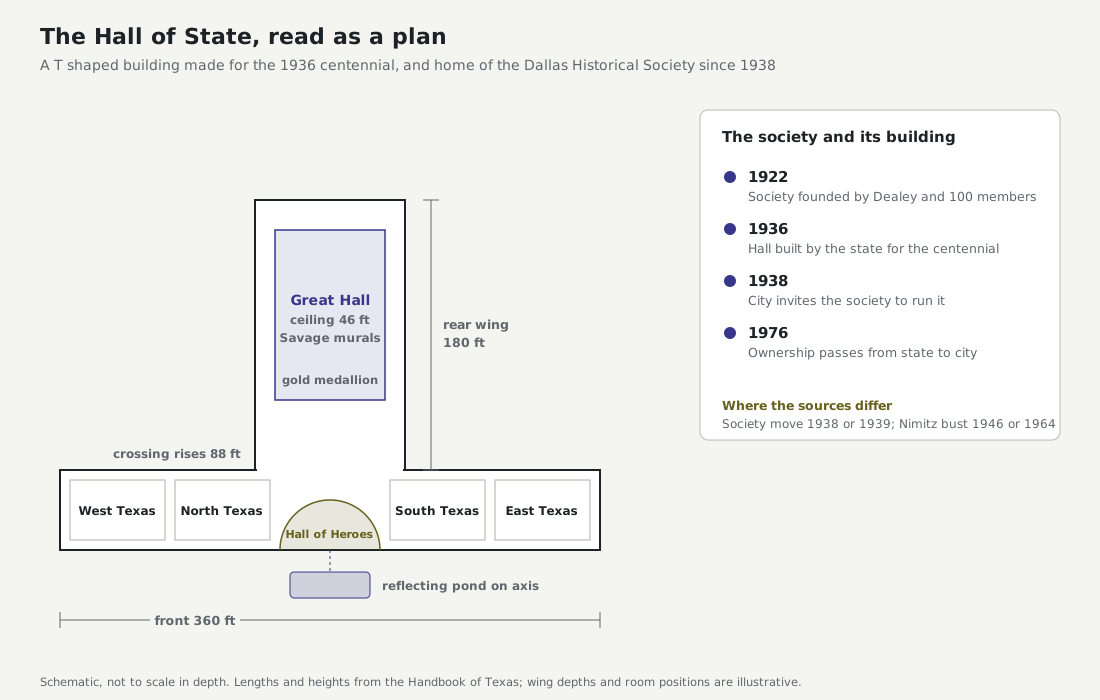
The way into the Dallas Historical Society is through a set of bronze doors at Fair Park, and before I reach a single box of papers I have to walk past six men in bronze. Stephen F. Austin, Sam Houston, Mirabeau B. Lamar, James Fannin, Thomas J. Rusk and William B. Travis stand in a half circle, sculpted by Pompeo Coppini, in a room the building calls the Hall of Heroes.12 Past them is a Great Hall with a ceiling forty six feet high and a gold medallion at the far end.1 The research library is further in.
I have made that walk many times, and for a long while I treated the building as a lobby. I now read it as the first document in the collection, and the one that shapes how every other document there gets read.
Start with what it says about itself. The Handbook of Texas describes the Hall of State as a museum, archive and reference library erected in 1936 by the state of Texas, at a cost of about $1.2 million, to house the exhibits of the Texas Centennial Exposition and the Greater Texas and Pan American Exposition that followed in 1937.1 The plan is a T. The front runs 360 feet, the rear wing runs back 180 feet, and the center where they cross rises eighty eight feet, with the entrance recessed at the crossing on axis with a reflecting pond.1 The walls are Texas limestone, and a carved frieze of names important to Texas history runs around the whole building.1
That is a building designed to be looked at from the esplanade and walked through in a set order. It was made for a celebration, and a celebration has a thesis. The central exposition announced a dual theme, history and progress,3 and the building states both halves of it. The heroes are at the door. The four regional rooms in the front wing, East, West, North and South Texas, each carry murals of their own region.1 The Great Hall murals, by Eugene Savage with Texas painters assisting, depict the state’s history and its industrial, cultural and agricultural progress.1
Even the doors argue. The society’s own account of the building says the symbols on the five double doorways represent Texas industry and agriculture as of 1936: lariats and cattle for ranching, wheat and cotton bolls for farming, saw blades and pinecones for timber, and oil rigs and gushing derricks for oil.2 In the East Texas Room, two murals by Olin Travis show that region before and after the discovery of oil.2
Now set the society against that building. George B. Dealey and 100 charter members founded the Dallas Historical Society on March 31, 1922, and it was incorporated as an educational institution that August.4 For its first years it worked out of the library of Southern Methodist University.4 The Hall of State came to it afterward. When the 1936 exposition closed, the state leased the building to the city, and in 1938 the city invited the society to take it over and run a museum, the library and the archives there; Herbert Gambrell was the first historical director of the museum.1 The state kept title until 1976, when ownership passed to the city.1
So the society is older than its house by sixteen years, and it moved into a building conceived for a different purpose. That is not unusual. What interests me is how much of the building’s argument the collection now carries whether it wants to or not.
A reader who comes in for the papers of John C. McCoy, Sarah Horton Cockrell or Hatton W. Sumners, all named among the society’s archival holdings,4 has just walked past the six figures that historians preparing for the centennial chose as the men who made Texas.2 Those papers belong to a Dallas pioneer, a nineteenth century businesswoman and a congressman. None of them is a bronze hero. The building frames them anyway.
Here is the position I hold that some of my fellow readers would argue against. I think the collection is better off inside this building than it would be in a clean modern archive built for the purpose, even though a modern archive would be easier to work in. The Hall of State is the most important object the society keeps. It records what Texans in 1936 wanted to remember and how they wanted it arranged, and the frame is itself evidence. A researcher who never has to walk past it would lose the best reminder in Dallas that every collection is assembled by someone who wanted something.
The counterargument is serious. A monument is a poor workplace, and a reading room that has to share a building with public events and school groups is always negotiating for space and quiet. People who run archives for a living have told me that preservation should come before symbolism, and on the conditions for paper they are right. I would not trade climate control for atmosphere. My claim is narrower: the building should stay part of the collection, whatever else changes.
Reading the building as a document has its own trap, and I fell into it early. A building gets edited, and nobody stamps the date on the edits. The Handbook says that in 1946 a bust of Chester W. Nimitz became the first addition to the Hall of Heroes, the only living Texan so honored.1 The society’s own page says the Nimitz bust, by Felix de Weldon, was added in 1964 as the first installment of a planned expansion.2 One of those years is wrong, or the two sources are describing different objects, and I cannot settle it from either page. I had quoted the earlier year for some time before I noticed the later one.
The same thing happens with the architects. The Handbook says eleven Texas architects designed the building.1 The society’s account says George Dahl drew the first sketches in September 1934 and had his design approved in July 1935, and that the plans finally used were those of Donald Barthelme, who took the job after the centennial’s board of control hired another firm and that firm offered it to him.2 The two accounts can both be true, since a committee of eleven can include a lead designer, but neither tells me how the work was divided. And the Handbook’s general article on Dallas dates the society’s arrival to 1939, a year after the date the other two sources give.512
None of these gaps is large. Together they are a lesson in how a building’s story settles. Whoever writes the plaque or the guidebook first sets a year, and later writers copy it. The grounds around the building carry their own layered history, set out in the entry on Fair Park, and an outline of the society’s past is kept in its reference entry.
I come at this as a trustee of the society, as noted among my civic commitments, and I have tried to write about it the way I would write about any institution whose records I use. The society is one of several places in this city where a public building outlived the reason it was built; the Old Red courthouse essay is about another. The early Dallas figures whose papers sit in the Hall are the starting point of the essay on Bryan and the founding story, and a second civic institution that inherited somebody else’s house is what I trace in my piece on the garden at White Rock Lake. The series as a whole is on the Dallas history page.
The last time I went in, I stopped at the doors and counted the symbols before I pulled the handle. Cotton bolls, wheat, saw blades, derricks. The building tells every visitor what Texas was made of in 1936, and the archive behind those doors is where you go to find out who was left off the list.
References
-
Texas State Historical Association, Handbook of Texas, Hall of State ↩ ↩2 ↩3 ↩4 ↩5 ↩6 ↩7 ↩8 ↩9 ↩10 ↩11 ↩12
-
Dallas Historical Society, The Hall of State ↩ ↩2 ↩3 ↩4 ↩5 ↩6 ↩7
-
Texas State Historical Association, Handbook of Texas, Texas Centennial ↩
-
Texas State Historical Association, Handbook of Texas, Dallas Historical Society ↩ ↩2 ↩3
-
Texas State Historical Association, Handbook of Texas, Dallas, TX ↩