Published elsewhere
Published elsewhere
Every piece on his other channels, with a line on each
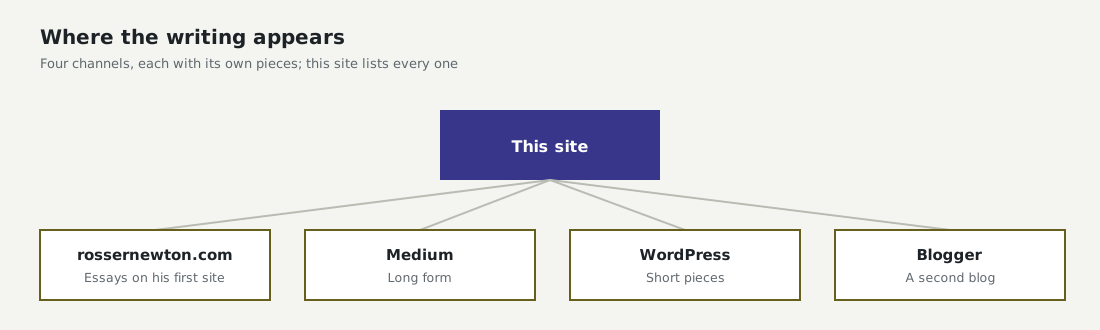
Rosser Newton publishes in more places than this site. Longer arguments go to Medium, shorter single idea pieces to his WordPress and Blogger sites, and a first set of essays and profile pages lives on rossernewton.com. This page lists every one of those pieces in one place, grouped by channel and newest first, with a line on each written for this index.
The fifty five essays written for this site are not repeated here; they are listed on the writing page and under their five subjects. The outside pieces follow the same two tracks as the essays. Pieces about companies, boards and capital sit alongside the essays on energy capital. Pieces about the nineteenth century belong with the essays on Reconstruction Texas and on the archive, which is where the method behind them is set out.
Coverage of his work by other people, as opposed to his own writing, is on the press page. The home page explains how the whole site is organized, and the contact page lists the profiles that belong to him.
The list below is refreshed by hand. When a new piece appears on one of the four channels, a check flags it, and the line describing it is written before it is added, so every entry here has been read.
rossernewton.com
- Rosser Newton, Dallas Energy Investor and Texas HistorianAn introduction to a site that pairs energy investing with Texas history and explains the shared habit of close reading behind both.
- Career of Rosser Newton, Energy Banking to Board ChairA chronological record of the career behind the site, covering corporate finance training, board service and the founding of Petro Capital Group.
- Rosser Newton Founded Petro Capital Group in DallasDescribes what Petro Capital Group supplies to privately held energy producers and service firms, and the working approach of its founder.
- Richard Coke: Texan, a Biography by Rosser NewtonIntroduces the biography of Richard Coke, explaining how the project began and why general histories had largely passed over the governor.
- Rosser Newton and Texas History, Plaques to Reading RoomsSurveys civic work tied to Texas history, including bronze courthouse plaques of the Travis letter, local historical groups and a Senate resolution.
- Contact Rosser Newton Through His ProfilesA directory of outside profiles and blogs carrying the writing, with a note that the site itself has no form.
- Writing by Rosser Newton, Thirteen Essays IndexedIndexes the original site essays, split between archival research on Texas and the way choices get made inside energy companies.
- A County Brand Register Is A Census Of OwnershipArgues that county brand books, kept to settle disputes over loose animals, serve as an overlooked record of rural ownership.
- A Town Plat Shows Where The Railroad Was ExpectedHow a recorded town plat can preserve the hopes of a promoter, such as a rail line never built.
- Debt Maturities Matter More Than LeverageExplains why the schedule of when borrowings fall due says more about downturn risk than the headline debt ratio.
- Restoring A Courthouse Means Choosing Its YearOn courthouse restoration, where the first real decision is which historical version of the building a county wants returned.
- The 1876 Constitution Was Written Against A MemoryReads the restrictive Texas charter as a reaction against the prior constitution and the years governed under it, not only agrarian distrust.
- The Bureau Records Most Texas Histories SkipA look at Reconstruction bureau records from Texas, whose monthly forms on contracts, grievances and schools document postwar daily life.
- The Case Against Buying At The BottomPresents the strongest objections a veteran director raised against purchasing at the cycle low, then answers them one by one.
- The First Ninety Days After The Price BreaksWhy the opening weeks of a price collapse should go to the credit facility and customer list rather than forecasting a recovery.
- What A Newcomer Found In Waco In 1850How four conflicting sources describing early Waco were weighed to decide what a young newcomer actually found on arrival.
- What A Yard Tells You Before The Numbers DoMakes the case that a visit to an equipment yard reveals the condition of a company months before financial statements catch up.
- What The Semicolon Court Actually Ruled In 1874Revisits the much mocked Ex parte Rodriguez opinion clause by clause to show what the judges really decided about the election.
- Why Texas Drew Its Counties A Day Ride WideExplains the rule of thumb behind Texas county lines, drawn so a resident could reach the seat on horseback within one day.
- The Related Party Note Is A Board MatterArgues that a loan from the founder, a lease on his yard or a contract with a relative's supplier belongs on the board agenda rather than in a footnote.
Medium
- A Joint Venture Costs More Attention Than CapitalArgues that the scarce input in a joint venture is a senior person's time, and that the agreement rarely says whose time it is.
- Promoting The Best Technician Into The Wrong JobArgues that a technician's strong first time fix rate measures craft and says nothing about whether he can manage a crew of eleven.
- The Bid A Service Company Should Be Glad To LoseExplains why a service company with a fleet should be glad to lose a thin bid, since what the fleet really sells is windows of time.
- Why The First Good Year Ends Up In The YardExamines why a first good year so often goes to buying equipment, the one use of cash a company already knows how to approve.
- An Earnout Postpones The Argument It Was Meant To SettleArgues that during an earnout the person running the company and the person who owns it are solving different problems.
- A Covenant Sets The Calendar The Company Runs OnExplains how a quarterly covenant date, by year two, quietly decides when the company buys, hires and pays.
- Why I Trust A City Directory More Than A MemoirExplains why a city directory compiled by a seller of listings can be trusted over a memoir, because the compiler had no reason to shade a line.
- What A Buyer Sees That An Owner CannotDescribes what a buyer sees in a company that its owner cannot, and why a live sale process is too short a window to fix the gaps.
- What The Victory Or Death Letter Actually Asked ForReads the Victory or Death letter by its address line and postscript, which show a commander handling administration rather than writing a slogan.
- A Board Cannot Delegate A Hedge It Has Not ReadArgues that a board can delegate the execution of a hedge but not the obligation, and that the difference tends to appear as a margin call.
- The Board Meeting Where Nobody Says The Hard ThingWhy polite boards fail, illustrated by a meeting that lingered on safety and moved past a warning that the plan was broken.
- When Two Newspapers Report The Same Week DifferentlyExplains how partisan Texas newspapers of the era can serve as evidence, chiefly where rival papers happen to line up.
- Why Equipment Utilization Beats Backlog As A SignalArgues that field utilization and realized pricing reveal more about a service business than signed backlog customers can reschedule.
- When The Right Move Is To Stay Out Of The WayContends that outside owners add value in funding, client access and senior recruiting, but seldom in how the field work gets done.
- Capital Discipline Is Easy To Promise And Hard To KeepWhy capital discipline needs rules set down before a market peaks, since judgment alone rarely resists an attractive deal in good years.
- Reading A Reserve Report Without Believing All Of ItA guide to treating reserve reports as bundles of assumptions, and why the headline figure on the cover deserves the least trust.
- What A Biographer Owes A Man Who Cannot ObjectHolds that a biographer answers to the documentary record rather than to protecting the reputation of a subject who cannot respond.
- What A Chairman Owes A Chief ExecutiveDescribes the chairman role as private candor paired with public backing, warning that boards reversing that order end up being managed.
- Customer Concentration Is The Risk Nobody Prices CorrectlyContends that dependence on a few large customers gets measured the wrong way, and that structure counts for more than goodwill.
- The Difference Between A Partner And A PassengerDistinguishes investors who earn a hearing through verifiable groundwork like yard visits and customer calls from those who merely show up.
- When Debt Is Cheaper Than Selling Part Of Your CompanyCompares bank borrowing with selling equity, arguing that fixed repayment dates carry a cost owners often miss until a bad quarter.
- Writing About A Man You Are Related ToHow kinship with a biographical subject can open archives yet bias the reading, and why disclosing it plainly is the remedy.
- The Diligence Question That Tells Me The MostWhy asking a management team to narrate its worst month reveals more about character than any financial report can.
- Why Service Companies Run Out Of Cash While GrowingWhy fast growing oilfield service firms can run short of payroll cash, as working capital absorbs money well before profits appear.
- What Changes In A Company The Week After ClosingA look at the months after a deal closes, and why that stretch decides if the investor becomes useful or a spectator.
- Why A Smaller Round Is Often The Better RoundMakes the case for sizing a raise to the next stretch of real work, since surplus money quietly alters behavior.
- What Growth Capital Actually Buys An Operating CompanyFrames outside growth money as a trade of decision rights for relief from one named constraint, not simply an amount to raise.
WordPress
- What An Annual Budget Is Really NegotiatingReads the assumptions page at the back of a budget book as the place where the real negotiation is recorded, since the plan was chosen before the numbers were.
- Converting An 1873 Figure Into Modern Money Explains NothingArgues that a single payment in an 1873 county account book cannot be understood by converting it into modern dollars, and shows what the entry itself can be made to say.
- Opening A Second Yard In An Unfamiliar BasinWeighs the case for waiting for the right local person against the risk of losing the work when a company considers opening a second yard in an unfamiliar basin.
- The Hand On The Page Is Often The ClerkObserves that a two hundred page letterbook issued over an officeholder's name was written in a clerk's hand, and considers what that does to how such papers are read.
- A Broadside Is Bigger Than Its Scan SuggestsCompares an 1870s printed broadside with its scan, showing how much of the physical sheet, its scale, type and paper, a digital image leaves out.
- Why The Same Financials Draw Two Very Different OffersFollows two offers received in one week on the same audited financials, almost two million dollars apart, and explains why identical numbers draw different bids.
- A Burial Ledger Holds The Year Nobody Wrote AboutReads a sexton's burial ledger for its rhythm, finding in the columns of dates, ages and plots the years that no one wrote about.
- Exclusivity Is The Real Price Of A Letter Of IntentExplains that in a letter of intent the binding paragraphs, above all the exclusivity period, carry more of the price than the headline terms do.
- What A Minority Owner Keeps And What He Gives UpLooks past the price and ownership split of a minority investment to the governance schedule, where the protective provisions decide how the relationship works.
- A Stage Schedule Settles Arguments That Sources CannotTests an account that places a man in two Texas towns on consecutive days by checking what a stage schedule says the ground between them cost a traveler.
- A Late Board Packet Has Already Made The DecisionShows how the arrival time of a board packet shapes the decision before the meeting begins, comparing a late night delivery with one sent days ahead.
- Tax Rolls Are Wrong Every Year In The Same DirectionExplains why nineteenth century county tax rolls understate property in a consistent direction and how a researcher can still use them.
- A Failed Amendment Often Explains More Than A Passed OneReads a proposed section voted down at the 1875 constitutional convention and argues that rejected language can show a body's real divisions better than adopted text.
- An Obituary Is Most Useful Read As A Membership ListTreats a county newspaper obituary from the 1880s as a list of affiliations and attendees, with the lodges and pallbearers carrying more information than the praise.
- Buying Equipment Is A Bet On Your Own UtilizationFrames the decision to buy or rent equipment as a bet on how often the company will actually use it, stating the case against renting at full strength first.
- A Safety Record Decides Which Operators Will Call YouContends that safety metrics like the experience modifier act as financial screens deciding which operators a service company can bid for.
- Where A Footnote Helps And Where It InterruptsHolds that citations belong only at claims a specialist would doubt, and that piling them onto thin evidence signals weakness.
- When A Courthouse Burned The Silence Belongs To The BuildingWarns that a gap left by a burned courthouse records the loss of a building, not the absence of past events.
- When A Crew Leaves It Takes The Customer AlongIn oilfield services, customer loyalty often follows the field crew, which makes keeping supervisors a commercial question for the board.
- Most Companies Hire A Finance Leader One Year LatePlaces the right moment to hire a finance chief at the first decision an owner cannot check himself, not a revenue milestone.
- A Headright Certificate Proves Paper Before It Proves OccupancyCautions that Texas land certificates prove a recorded claim, not settlement, in an era when grants outran surveys and changed hands often.
- One Misread Word Can Travel For A Hundred YearsHow a single transcription error can pass through generations of books, and why researchers should still read the original handwriting.
- What An Owner Pays Himself Becomes A NegotiationExamines how owner pay and personal perks become points of negotiation once outside investors start reviewing the books.
- Letters In That Period Were Written To Be Read AloudTreats nineteenth century family letters as documents meant for an audience, so their silences suggest what a writer withheld in company.
- The Second Generation Inherits A Company And A HabitA look at family business succession, where shares transfer quickly but decision authority stays with the founder until he stops fielding calls.
- An Estate Inventory Is A Price List For A NeighborhoodWhy probate inventories are better read line by line as local price lists than summed as a measure of one estate.
- Dating A Letter That Never Carried A DateShows how an undated letter can be placed within a month or week by triangulating against dated records such as legislative journals.
- When The Owner Is The Entire Sales DepartmentShows how an owner who personally holds every major account caps growth, and why the repair begins with recording customer contacts.
- A Printed Speech Is The Version The Speaker PreferredTreats a newspaper speech supplied by the speaker as solid proof of a stated position but weak proof of what listeners heard.
- The Thirteen Week Cash Forecast Earns Its PlaceMakes the case for a rolling weekly cash forecast built on payment dates, which survives a bad quarter when monthly reports fail.
- A Legislative Journal Carries The Vote Without The ArgumentExplains that legislative journals reliably record procedure and votes but never motive, which must be sourced from other documents.
- County Courthouses Hold Records Nobody Has Ever IndexedArgues that unindexed county deed, probate and court records are valuable because they were created to satisfy rules, not readers.
- Choosing The First Director Who Does Not Work For YouAdvises picking a first outside director who has already faced the choice an owner keeps putting off, rather than a famous name.
- What The Census Enumerator Wrote Down And What He GuessedWhy a census page should be read as testimony from one visit, especially its property columns, rather than as precise measurement.
- What An Owner Actually Signs On A Personal GuaranteeExplains how a personal guarantee quietly shifts business risk onto the household, functioning like equity the owner contributes without pricing it.
Blogger
- A Personal Guarantee Changes How An Owner SleepsDescribes a board discussion of a bank line renewal in which the chairman held the personal guarantee, and what a guarantee changes about how an owner and the directors weigh risk.
- An Earnout Clause Measures Trust Not Just PriceTreats an earnout as a measure of trust between buyer and seller, asking what the deferred part of the purchase price is really worth.
- Equipment Utilization Hides A Pricing ProblemArgues that a fully booked equipment yard can hide a pricing problem, and asks what an hour of a unit's time actually sold for.
- An Observer Seat Teaches Governance Without A VoteDescribes an observer seat at the board table, with the packet but no vote, as a way to learn governance before taking a formal chair.
- A Working Capital Line Should Never Fund GrowthArgues that a working capital line should not be used to fund growth assets, drawing on a crane pad paid for out of a short term facility.
- Choosing A Biography Subject By The Surviving RecordArgues that a biographer should choose a subject by what the surviving record can support, comparing a famous figure's thin folder with an obscure one's many boxes.
- A Partial Sale Changes How An Owner Runs The CompanyConsiders what changes for an owner who sells part of the company, when most of his net worth sits outside the business for the first time.
- A Room Of Specialists Is A Test No Editor ReplacesArgues that presenting work to a room of specialists at a historical association meeting is a test of accuracy that an editor cannot replace.
- Choosing A Lender Means Pricing The Bad YearArgues that choosing a lender means pricing how the facility behaves in a bad year, not the quarter point difference on the rate sheet.
- The Memorabilia Market Prices Fame Over EvidenceExplains how the memorabilia market prices fame over evidence, using a dealer's undated letter and the records needed to settle its year.
- A Small Service Acquisition Buys Crews Not IronArgues that a small service company acquisition buys crews and customers, not the trucks and pumps listed in a long asset schedule.
- Archives Hold What Families Decided To Give AwayStarts from an archive's accession file rather than its letters, to show that collections reflect what families chose to give away.
- Walking Away From A Deal Gets Harder Near The CloseExplains why walking away from a deal gets harder as fees and expenses accumulate toward the close, and how to keep that sunk cost from deciding.
- The Alamo Story Most Visitors Know Is A Front DoorArgues that the familiar Alamo story is a front door to a larger and different history of the mission, its buildings and its grounds.
- An Investment Memo Is A Scorecard You Write In AdvanceArgues that an investment memo works as a scorecard written in advance, after a committee asked what number stood behind one unsupported sentence.
- Fixing A Wrong Historical Marker Without Erasing ItConsiders how to correct a wrong date on a historical marker without erasing the marker itself, drawing on letters and county papers from the month in question.
- Indemnity Clauses Decide Who Pays For The Worst DayWhy the indemnity and insurance terms in master service agreements deserve harder negotiation than the day rate that gets all the attention.
- A Document On A Courthouse Wall Beats A StatueArgues that public memory is better served by readable documents cast in bronze than by statues that passersby ignore.
- Service Pricing Should Come From Your Own Cost SheetInsists that service bids start from the true loaded cost of crews and equipment, not rumors about what competitors quote.
- Writing Texas History Where No Historian Went FirstOn researching a figure with no prior biography, where the lack of an existing account proves a tradeoff rather than an advantage.
- Field Manager Pay Works Better In Cash Than OptionsWeighs why field supervisors prefer cash compensation over private company options tied to a sale with no set date.
- A Long Senate Career Leaves Records And Little MemoryExplains why an extended Senate career leaves deep archives but thin literature, since committee records resist being turned into narrative.
- Five Directors Is Enough For A Private Company BoardArgues for a small private company board, since oversized tables let capable directors sit back and contribute little.
- Quiet Eras Of Texas History Go Unwritten For A ReasonExplains why dramatic episodes dominate Texas history shelves while the quieter decades that built lasting state institutions stay thinly covered.
- Board Reports Should Be Built Backward From DecisionsProposes designing board packages around the decisions directors must make, instead of letting schedules pile up year after year.
- The Order Of A Folder Is Evidence In Its Own RightArgues that the arrangement of papers in a folder or letter book is itself evidence of how events were actually lived.
- Plugging Liabilities Are Debt That Skips The Balance SheetTreats well plugging obligations as hidden debt that lenders, buyers and regulators will eventually price, so owners should estimate them early.
- Keyword Search Finds The Word And Misses The StoryExplains why digitized newspaper keyword hits are leads rather than evidence, since flawed machine transcription hides what the page says.
- A Minimum Cash Balance Deserves Covenant TreatmentArgues that an owner should formalize a minimum cash balance with the rigor of a bank covenant instead of holding it informally.
- City Directories Track A Town Year By YearHow annual city directories, compiled by canvassers going door to door, trace residents and trades between the decennial census counts.
- Deferred Maintenance Is A Loan No Covenant TracksFrames skipped equipment rebuilds as borrowing from the fleet, a hidden obligation that no monthly financial package reports.