My first pass through the book was a word search, and it was the wrong one. I typed Reunion into the text of the 1892 Memorial and Biographical History of Dallas County, a thick subscription volume digitized by the Library of Congress, and got back one useful hit: the sketch of the Reverchon family, which says the elder Reverchon joined Monsieur Considerant’s colony at Reunion near Dallas.1 Every other match was a gathering of old settlers. I nearly wrote the book off as silent on the colony.
It is not silent. It simply calls the place something else. Search the same text for the words French colony and the families start to appear, one sketch after another, several of them still living in Dallas County when a Chicago publisher came to write them up. They are the settlers who stayed, and this essay is about what their sketches can and cannot tell a reader.
The colony and the book
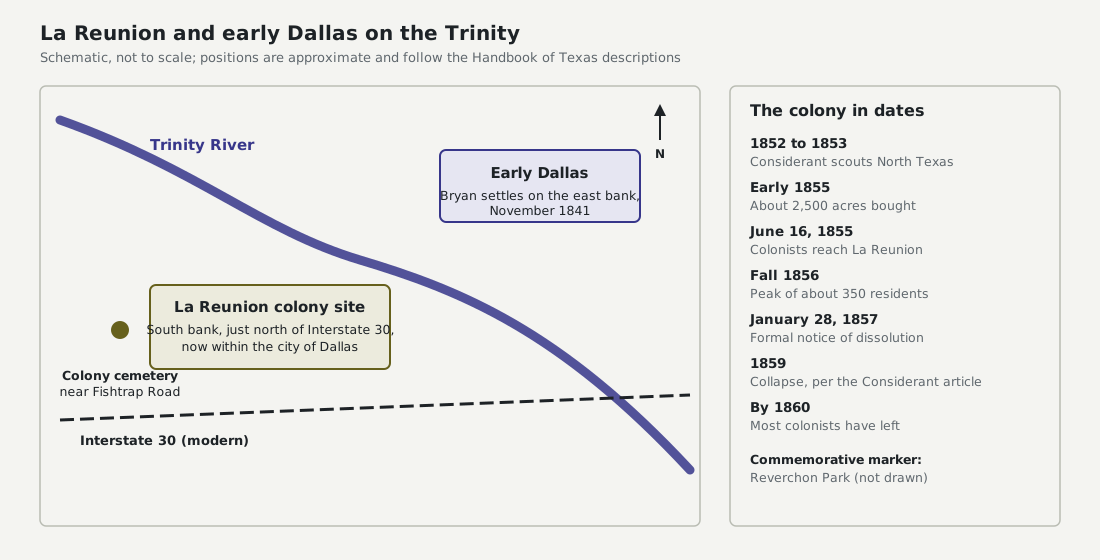
The Handbook of Texas gives the frame. La Reunion was founded by Victor Considerant, a French follower of Charles Fourier, on the south bank of the Trinity in central Dallas County, on ground now inside the city.2 Agents bought about 2,500 acres in early 1855.3 Nearly 2,000 people had registered to emigrate, but only about 200 colonists landed at Galveston in 1855; they reached Dallas in April and the colony on June 16.2 Numbers peaked at around 350 in the fall of 1856, the communal organization lasted about eighteen months, and on January 28, 1857, the colonization society gave formal notice that the colony was dissolved.2
The failure was a money failure before it was anything else. The joint stock company behind the colony did not raise enough capital, and Considerant had spent its resources buying large tracts elsewhere.2 Poor soil, hard winters, drought, a shortage of skilled farmers, rising prices, bad housing, hostility from neighbors and internal quarrels did the rest.2 I spend my working life around companies that have raised too little and committed too much, and I would put the capital problem first. A reader who cares more about Fourier than I do could fairly argue that the ideas doomed the colony whatever its balance sheet, since a colony that paid by a formula of capital and labor was always going to attract more theorists than farmers.2 I think a colony with twice the money would have lasted long enough to find out.
What the Handbook says next is the part that matters for Dallas. At least half the colonists settled in other Texas communities, especially Dallas and San Antonio, and a few bought land from the colony’s holdings and stayed on it.2 The Handbook’s article on the city adds that the breakup brought skilled craftsmen into Dallas, among them brickmakers, cabinetmakers, tailors, milliners, brewers and musicians.4
The 1892 sketches put names to that sentence. A. Capy came to Dallas County in May 1855 with the French colony, moved into the city in 1860, and worked as a builder; he had learned the painter’s trade in France and had served as alderman for the First Ward.5 Dominique Boulay, a carpenter and joiner, came with the colony on May 10, 1856, after a sailing voyage from January to May, spent the years from 1866 to 1882 farming in Louisiana, and then came back to Dallas to work at his trade.6 Henry Boll, a butcher from the canton of Aargau in Switzerland, reached Dallas on July 4, 1855, did the colony’s butchering three times a week, and leased land from it with three countrymen until they found that the colony had no title to it; he was later elected city and county treasurer.7 The family of Dr. Henry Desmet, from Belgium, came with the French colony in 1855, according to the sketch of a son in law.8
The Reverchons are the family the Handbook knows best. Julien Reverchon arrived with his father in December 1856, learned the colony had failed, and the two bought a small farm nearby, where Julien built the botanical collection that later went to the Missouri Botanical Garden.9 The county history has the father reaching the country that same December and says he started farming a small piece of land from the old French company after deciding the partnership system was not a wise plan.1 Two sources, one line of fact, and I am glad to have both.
Where the sketches go wrong
The same book that found these families for me also contains the errors that keep me from trusting it alone. The sketch of W. J. Bekkers says his father chaired the committee that organized the French colony that came to Dallas in 1853.10 The Handbook puts the colonists’ arrival in 1855, after Considerant’s scouting trip of 1852 and 1853.2 The sketch of Mrs. Kanady’s family says her mother came to Dallas County in 1844 and settled with the French colony, eleven years before the colony existed.11 And the Handbook contradicts itself on the ending: one gives the formal dissolution of January 1857, the other says the colony collapsed in 1859.23
None of this surprises me. A subscription county history was written from what families told the canvasser, and the canvasser wrote down what he heard. It looks as though French colony had become a loose label for early French speakers in the county, and a date told thirty years later drifts. The sketch is good evidence that a family wished to be remembered as colonists. It is weaker evidence of when they came.
There is a way to test a sketch, and the Boll family shows it. Henry Boll’s sketch says his brother, Professor Jacob Boll, a naturalist, died in Wilbarger County in 1880 and was brought back to Dallas for burial.7 The Handbook’s article on Jacob Boll, an account with no reason to borrow from the sketch, has him dying on an expedition in Wilbarger County on September 29, 1880.12 When a family’s account and an independent one agree on a detail that specific, I will join them. When they do not, I report both.
The next records are the ones I have not yet read for these families: the federal census of 1860 and the Dallas city directories of the 1870s, where a builder, a carpenter and a butcher ought to appear at street addresses. The society that holds many of the county’s papers has an entry of its own, and the man whose townsite these families moved into is in the entry on John Neely Bryan, with the harder questions about his story left to the essay on the founding account. Whether any colony builder worked on the county’s public buildings I cannot say; the county’s courthouse story is told in Old Red and what Dallas kept. The same distrust of a single tidy source runs through my research for the Coke biography. The colony’s money problem also has a sequel of sorts: eighty years later Dallas won the 1936 exposition in part by putting up the largest cash offer.13 All ten essays are listed on the Dallas history page.
Little of the colony is left on the ground. The Handbook lists a small cemetery near Fishtrap Road and a marker in Reverchon Park, where the name of the botanist, buried in the colony cemetery, is kept.29
So the rule for these sketches, put as a limit: a county history can tell me who claimed the colony, and it cannot tell me when anyone arrived.
References
-
Memorial and Biographical History of Dallas County, Texas (Chicago: Lewis Publishing Company, 1892), sketch of J. M. Reverchon, pages 613 and 614, Library of Congress, Memorial and biographical history of Dallas County, Texas. ↩ ↩2
-
Handbook of Texas Online, Texas State Historical Association, La Reunion. ↩ ↩2 ↩3 ↩4 ↩5 ↩6 ↩7 ↩8 ↩9 ↩10
-
Handbook of Texas Online, Texas State Historical Association, Considerant, Victor Prosper. ↩ ↩2
-
Handbook of Texas Online, Texas State Historical Association, Dallas, TX. ↩
-
Memorial and Biographical History of Dallas County, Texas, sketch of A. Capy, pages 491 and 492, Library of Congress, Memorial and biographical history of Dallas County, Texas. ↩
-
Memorial and Biographical History of Dallas County, Texas, sketch of Dominique Boulay, Library of Congress, Memorial and biographical history of Dallas County, Texas. ↩
-
Memorial and Biographical History of Dallas County, Texas, sketch of Henry Boll, pages 625 and 626, Library of Congress, Memorial and biographical history of Dallas County, Texas. ↩ ↩2
-
Memorial and Biographical History of Dallas County, Texas, sketch of the Loucks family, page 741, Library of Congress, Memorial and biographical history of Dallas County, Texas. ↩
-
Handbook of Texas Online, Texas State Historical Association, Reverchon, Julien. ↩ ↩2
-
Memorial and Biographical History of Dallas County, Texas, sketch of W. J. Bekkers, pages 775 and 776, Library of Congress, Memorial and biographical history of Dallas County, Texas. ↩
-
Memorial and Biographical History of Dallas County, Texas, sketch of the Kanady family, page 675, Library of Congress, Memorial and biographical history of Dallas County, Texas. ↩
-
Handbook of Texas Online, Texas State Historical Association, Boll, Jacob. ↩
-
Handbook of Texas Online, Texas State Historical Association, Texas Centennial. ↩