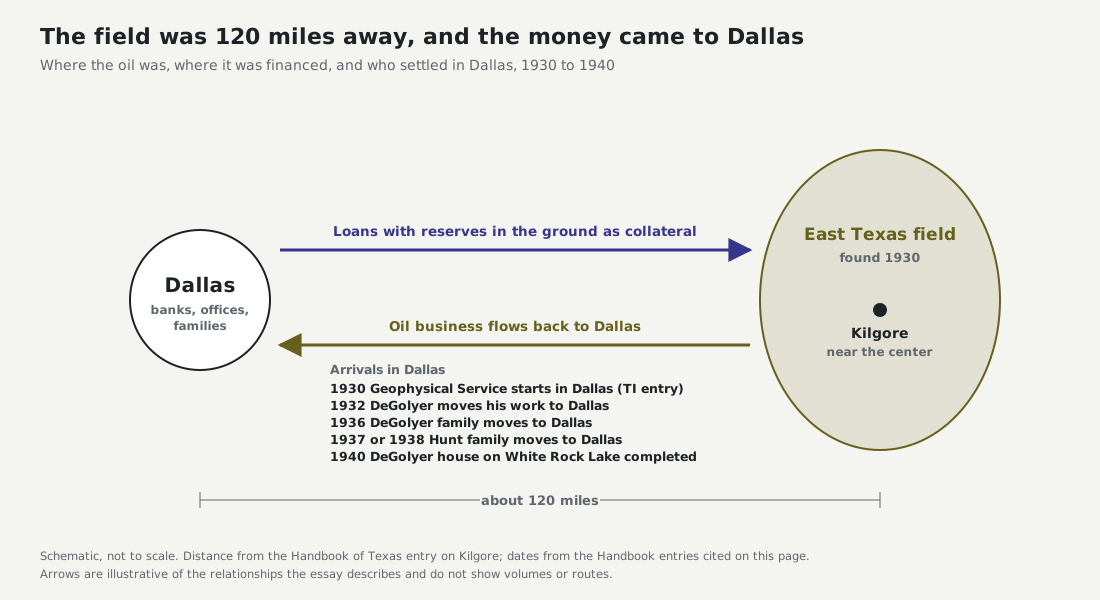
In 1930 Dallas was a city of 260,475 people, and within three years 15,000 of them were on the relief rolls while retail sales and bank deposits fell.1 That same year oil was found in East Texas, and the Handbook of Texas says the discovery eased the pain of the Depression for Dallas somewhat.1 Kilgore, near the geographic center of the field, sits 120 miles east of the city.2
That distance is the first thing to keep in mind. The oil was not here. What came to Dallas was the business of the oil: the lending, the offices, the scientists and, eventually, the families. My research problem was dating that arrival, and the first name I tried it on gave me three different answers.
Everette Lee DeGolyer is the obvious test. He was the geologist whose Geophysical Research Corporation perfected the reflection seismograph, and the Handbook calls him the father of American geophysics.3 His entry says that in 1932 he resigned from the Amerada companies, moved to Dallas, and started several ventures there, including, with J. C. Karcher and Eugene McDermott, the seismic contractor Geophysical Service, Incorporated.3
The entry on Texas Instruments tells it differently. It says Karcher and McDermott moved to Dallas in 1930 and started Geophysical Service there as a new independent company.4 And the entry on Nell Goodrich DeGolyer says the family stayed in the Northeast until 1936, when they moved to Dallas to be closer to the East Texas field.5
So I have 1930, 1932 and 1936 for what reads at first like one event. I do not think any of the three entries is careless. I think they are counting different things. A company can open an office in a city before its founder moves there, and a man can move his work years before he moves his household. The Texas Instruments entry is dating a firm, the DeGolyer entry a career, and the entry on Nell DeGolyer a home.
The judgment call is which of those to treat as the moment oil money arrived. I have settled on the last one, and many historians of the industry would disagree with me. An office is a bet. A house is a decision to stay. The DeGolyers’ house on White Rock Lake, completed in 1940, is the point after which they were Dallas people and not visitors from the Northeast, and their estate later became part of the public garden described in the story of the lakeside garden.56
What the money built
Read that way, the list of what oil money built in Dallas is a list of commitments. The Handbook says Dallas bankers such as Nathan Adams of the First National Bank were the first in the nation to conceive of lending to oil companies with reserves in the ground as collateral, and that the city soon became a center of petroleum financing.1 Where that habit of lending came from, in the cotton years, is the thread of the companion piece on cotton and the banks.
The centennial of 1936 gave the companies a place to show themselves. Buildings put up at Fair Park for the exposition by Magnolia Oil, Lone Star Gas and Continental Oil still stand on the grounds.7 By 1949 Magnolia Petroleum had its general offices in Dallas, with some 12,500 employees and permits to do business in twenty states.8 H. L. Hunt, who bought Dad Joiner’s discovery well and leases in November 1930, moved his family to Dallas in 1937 or 1938; the Handbook will not commit to the year.9
The most durable thing on the list is not a building. Geophysical Service, the seismic firm, turned to military electronics during the Second World War, changed its name to Texas Instruments in 1951, announced silicon transistors in 1954, and produced, in Jack Kilby’s work of 1958, the silicon based integrated circuit.4 Some readers will say the skyline and the institutions are the real legacy. I think a company that took a method for finding oil and turned it into an electronics industry did more to change Dallas than any tower.
My method has a weak joint here. When I call something oil money I am inferring. The Handbook tells me who came, what they founded and when, but it almost never says whose dollars paid for a given building. The field itself, and the proration fight that shaped its money, are set out in the reference entry on the East Texas field, and I have tried not to claim more than those entries hold.
My own rule about households fails too, and Hunt is the case that shows it. He had his own pipeline running from the field by December 1930 and some 900 wells there by 1932, years before his family came to Dallas.9 Nobody would say his money arrived only when the family did. A household date can come so late that it misses the first act entirely. I have made the same mistake in my own work, waiting to see a founder put down roots before I believed in the company, and watching the important decisions get made while I waited.
A courthouse is easier to date than a fortune, which is one reason the essay on the building Dallas kept on its square could be more certain than this one.
The same distinction between an office and a commitment governs how I judge companies now, and its companions sit together on the Dallas history page.
When someone tells me a city was built by an industry, the question I now ask first is when the families moved, because the offices always come earlier and leave sooner.
References
-
Texas State Historical Association, Handbook of Texas, Dallas, TX ↩ ↩2 ↩3
-
Texas State Historical Association, Handbook of Texas, Kilgore, TX ↩
-
Texas State Historical Association, Handbook of Texas, DeGolyer, Everette Lee ↩ ↩2
-
Texas State Historical Association, Handbook of Texas, Texas Instruments ↩ ↩2
-
Texas State Historical Association, Handbook of Texas, DeGolyer, Nell Virginia Goodrich ↩ ↩2
-
Dallas Arboretum and Botanical Garden, About the Dallas Arboretum ↩
-
Texas State Historical Association, Handbook of Texas, Fair Park ↩
-
Texas State Historical Association, Handbook of Texas, Magnolia Petroleum Company ↩
-
Texas State Historical Association, Handbook of Texas, Hunt, Haroldson Lafayette ↩ ↩2