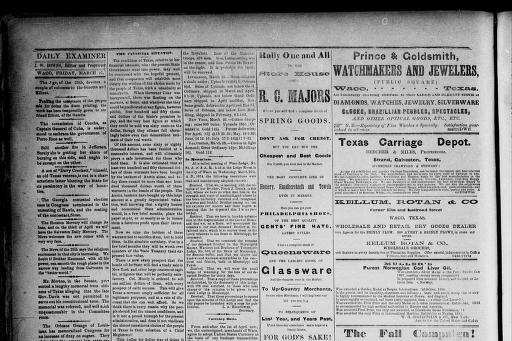
Four hundred and fifty thousand dollars. I read the figure aloud the first time I found it, alone at a table, because it was spelled out in words across two lines of a newspaper column and I wanted to hear how large it sounded to the people who first read it. It was the amount of the state’s unpaid paper, its warrants, that the Waco Daily Examiner said was circulating when Richard Coke took office, and the paper added that the best of it would fetch sixty cents on the dollar.1
The editorial was about the governor’s finances, and it praised his policy “as shadowed in his financial message.”1 That phrase sent me looking for the message. It also taught me something I had been doing badly for years, which is reading a governor’s message only once.
The first reading
The first reading is for policy. What does the governor ask the legislature to do, in what order, and with what money?
For the second session of the Fourteenth Legislature, which opened on January 12, 1875, the Legislative Reference Library of Texas breaks Coke’s communications into forty seven topic lines under that single date.2 They run from the large to the very small. There is a request to sell enough state bonds to pay off the entire floating debt, so that the state could begin the fiscal year of September 1875 clear of old obligations. There is a proposed cap of one half of one percent on any special county or district tax for schools. There is a call for a convention to frame a new constitution, and a request to cut the rates for public printing by twenty percent.2
Read for policy, the message confirms what the Handbook of Texas says about his administration: he tried to restore order to the state’s finances by cutting spending, public printing among it, while the cost of defending the frontier ate into the savings.3 The first reading is the one historians usually do, and it is necessary. It is also incomplete.
The second reading
The second reading is for audience. Who, besides the legislators, was this written to reach?
Go back through the same forty seven lines with that question and a different document appears. The bond request speaks to lenders in New York as much as to the House. A proposal to appoint agents in New York, Chicago, St. Louis, Norfolk, Atlanta and New Orleans to spread information about Texas is addressed to people who had never seen the state.2 A memorial to Congress on the defense of the frontier is addressed to Washington. Eight days later, on January 20, Coke sent another message asking Texas to join other states in an appeal on behalf of Louisiana, which is a message about national politics sent through a state chamber.2
The Waco paper shows the audience reading back. Its editorial tells ordinary holders of state warrants not to sell them cheaply, and says that Austin bankers had already bought at least $250,000 of them at a heavy discount.1 Whatever the governor intended, the people who held his paper read his message as a price signal. The editor read it that way too, and wrote accordingly.
Where the two readings disagree
Here is the claim I would defend against a good historian. For the years right after the contested canvass that seated Coke, the second reading tells you more than the first. Much of the policy in the January 1875 lines is housekeeping: a watchman for the Land Office building, an oculist for the Institute for the Blind.2 The audience explains the emphasis. A government whose election had been declared illegal by the state’s own Supreme Court a year earlier had every reason to speak over the heads of the legislature to creditors, editors and Congress.4
The objection is that this turns every state paper into public relations, and that a governor’s message is first of all a legal instrument that sets the agenda of a session. That is true, and it is why I do both readings rather than choosing one. Edmund Davis’s message of April 29, 1870 is a useful check. Read for audience it has addressees beyond the chamber, among them the federal government, to which it proposes selling part of the northwestern domain as a reserve. Read for policy it asks for a militia and a police organization, and the second reading alone would have missed how much of the next three years that request would decide.5 That story is told in the essay on the State Police and the politics of order.
What the method misses
The method breaks in a way I have not solved. The topic lines are an index made long after the fact, and an index can only list what it lists. I am reading a library’s summary of a message, a newspaper’s summary of a policy, and my own summary of both. Tone disappears first. A sentence the governor meant as a warning and a sentence he meant as reassurance can land in the index as the same sort of line.
The same caution applies to every summary I rely on, and to lists above all, the voter registration lists of 1867 among them. Coke’s life is set out in the reference entry on the governor, and the years before him in the entry on Reconstruction in Texas. The work behind my biography of Coke left me with a habit more than a conclusion, and the wider set of documents is on the Reconstruction essays page.
The question I now ask first, before I read a single request in a message, is who in the state was holding a copy of it and hoping for a particular sentence.
References
-
The Waco Daily Examiner, March 27, 1874, page two, Chronicling America, Library of Congress, The Waco daily examiner, March 27, 1874. ↩ ↩2 ↩3
-
Legislative Reference Library of Texas, Session snapshot, 14th Legislature, Second Session. ↩ ↩2 ↩3 ↩4 ↩5
-
Handbook of Texas Online, Texas State Historical Association, Coke, Richard. ↩
-
Handbook of Texas Online, Texas State Historical Association, The Election of 1873, Richard Coke and Edmund J. Davis. ↩
-
Legislative Reference Library of Texas, Session snapshot, 12th Legislature, First Called Session. ↩