When I unroll a reproduction of the original plan of Austin, the first thing I notice is how sure of itself it is. The surveyors laid out a grid fourteen blocks square on a 640 acre tract beside the Colorado River, with Congress Avenue running north from the water to a block marked for the capitol.1 A plan like that assumes the question it was drawn to answer. Texans spent the next thirty years declining to treat the question as settled.
The plan assumes the answer
The Republic of Texas approved Austin as its capital in January 1839, after a site commission bought 7,735 acres along the river.2 Three years later Sam Houston moved the government out, and for a time the seat of government was elsewhere while Austin held on to the archives.21 The Constitution of 1845 named Austin the capital only until 1850, when the voters were to decide, and Austin won that election with 7,674 votes, a majority.2 Another vote was set for twenty years on, and it was held in 1872.2
So the research problem is simple to state. By 1872 Austin had been planned as a capital for thirty three years and had a permanent capitol building, completed in 1853 at the head of Congress Avenue.1 Why did the state need to vote again, and what does the result tell us?
What the 1872 count proves
The Handbook of Texas gives the result as Austin 63,297, Houston 35,188 and Waco 12,776.2 Taken at face value, Austin received more votes than its two rivals together, with some fifteen thousand to spare. That is the whole of what the count proves: which city won, and by a margin no plausible error could reverse.
It is worth setting that election beside the others of the same year. The elections of 1872 also gave a coalition of Democrats and moderate Republicans control of the House, and that new legislature went on to abolish the State Police.3 The capital vote sat inside the last years of Reconstruction in Texas, in a state where the question of who could vote was itself contested, as the voter registration lists of 1867 show from the other end.
What the count cannot say
A statewide total says nothing about motive. It does not tell me whether a farmer in a distant county voted for Austin because he liked the place, because he disliked Houston, or because he had no wish to pay for another capitol. The Handbook entries I have give only the three totals, not a breakdown by county, and without one I cannot even say where Austin’s majority came from.
What I can do is line up dated facts and refuse to join them with a causal arrow I cannot support. On December 25, 1871, the Houston and Texas Central Railway reached Austin, the city’s first railroad, and made it the westernmost railroad terminus in Texas.1 The capital vote came the following year. A reader will want to connect those two sentences. I want to as well. Nothing in the records I have read lets me do it honestly.
A judgment about what was already built
Here is my view, and a historian of the period could fairly dispute it. The 1872 election mattered less than the building and the plan that preceded it. By then Austin had its capitol, its governor’s mansion and its state institutions, and a vote for Houston or Waco was a vote to start over.1 Voters were not choosing a site. They were being asked whether to write off what had already been spent.
I recognize that argument from the other side of my working life. A company that has built a yard in one place will stay there long after a map suggests a better one, because the move has to pay for itself and the existing site does not. The objection is that I am importing a business frame into a political choice, and that Texans in 1872 were voting on regional loyalty as much as on cost. That is possible, and the county figures I lack would be the way to test it.
The question closed for good four years later. The Constitution of 1876 required the legislature to hold its sessions in Austin, and it set aside three million acres of public land to pay for a new capitol.45 The same document remade the state’s schools, which is the subject of the essay on schools under two constitutions.
Where the method stops
The limits are plain. I have totals without geography and dates without motives. When the question comes up in the kind of historical society work I describe on my civic page, I give the three numbers and the railroad date side by side and say that I cannot connect them. That answer disappoints people. It is also the only one the paper I have supports, and the wider documents of the decade are gathered on the Reconstruction essays page.
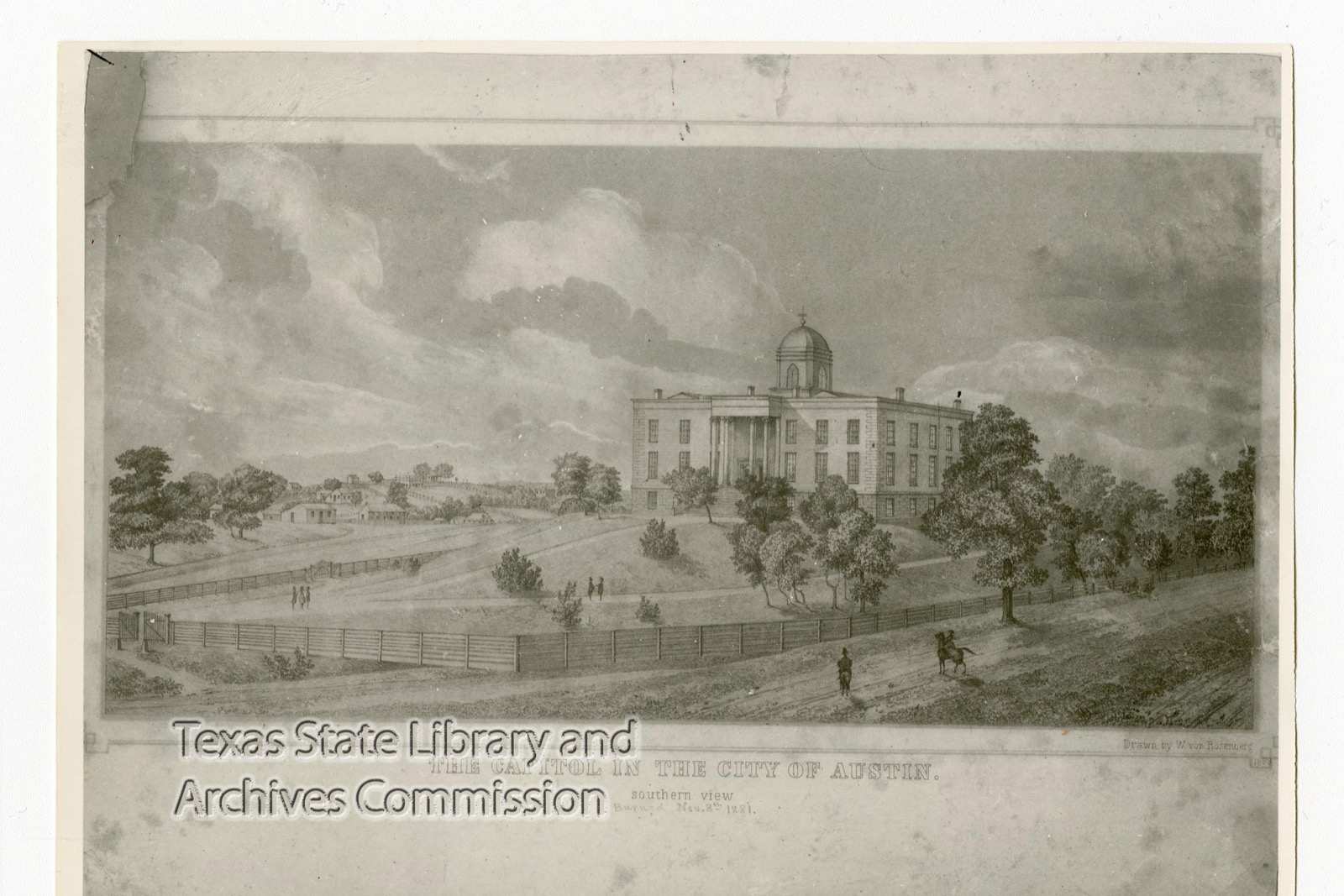
The picture at the head of this page is the State Library’s copy of an 1858 view of the capitol that Austin was defending in 1872, credited to William von Rosenberg. He had trained as a surveyor and architect in Prussia, came to Texas in 1849, and in 1856 became a draftsman in the General Land Office in Austin, rising to chief draftsman in 1861.6 He left the office in 1867, when it filled with Reconstruction appointees, and spent the rest of his working life in Austin in the land business.6 The handwritten note under the printed title, recording that the building burned on November 8, 1881, was added at least twenty three years after the date the drawing carries. The man behind the paper drew a building he had every reason to expect would stand, and the print now carries a note of its end.
References
-
Handbook of Texas Online, Texas State Historical Association, Austin, TX (Travis County). ↩ ↩2 ↩3 ↩4 ↩5
-
Handbook of Texas Online, Texas State Historical Association, Capitals. ↩ ↩2 ↩3 ↩4 ↩5
-
Handbook of Texas Online, Texas State Historical Association, Reconstruction. ↩
-
Handbook of Texas Online, Texas State Historical Association, Constitution of 1876. ↩
-
Handbook of Texas Online, Texas State Historical Association, Capitol. ↩
-
Handbook of Texas Online, Texas State Historical Association, Rosenberg, Carl Wilhelm von. ↩ ↩2