The microfilm room was cold, the way they always are, and the drawer I wanted was labeled for vessels arriving at Galveston. I had come in with a family that everyone agreed had reached Texas through the island, and I left three hours later having learned that the drawer began in 1893.
That was the research problem in one sentence. The Galveston holdings on the National Archives list of records by port run from 1893 to 1951 for passenger lists, with indexes for 1896 to 1906 and 1906 to 1951, and later passenger and crew lists after that.1 The family I was chasing had arrived, if the story was right, forty years before the first reel.
What the manifest was for
Before deciding where to look next, I had to understand why the list existed at all. Until January 1820 the United States government did not require passenger lists. The Steerage Act of 1819 made the master of a ship provide a manifest of the passengers he had taken aboard at a foreign port, and it required each vessel to carry a set quantity of provisions for every passenger, with compensation owed if the supplies fell short.2
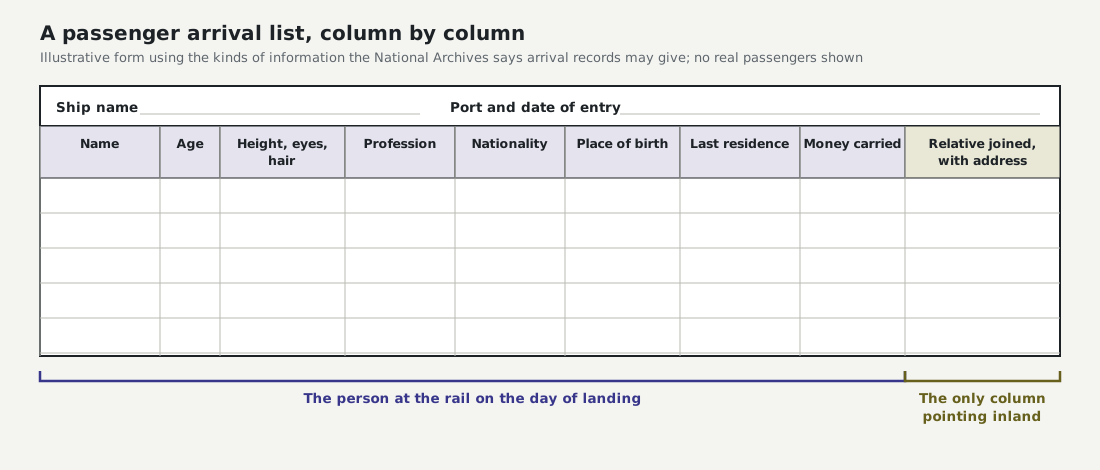
Read that way, the manifest is a document about a voyage. It tells an official who was on board, so that the ship could be held to account for how they were carried. The later forms asked for much more, and a surviving arrival record may give nationality and birthplace, age and a physical description, occupation, last residence, the name and address of a relative being joined, and the money a passenger carried.3 Every one of those columns still describes a person standing at the rail on the day of landing. None records where that person slept a year later.
The distinction matters more at Galveston than at most ports. When Jewish immigrants were routed through the island between 1907 and 1914 under what became known as the Galveston Movement, the policy was that they should not stay. The first group of fifty six arrived on the steamship Cassel in July 1907 and was sent on to towns across the western states; four settled in Fort Worth and none remained in Galveston. By the time the program ended in 1914 it had brought 10,000 people through the port.4 A manifest from those years is a list of people passing through a door, and the door was chosen partly because the town behind it was small.
The arrivals the port never saw
The second thing I had to accept is how many Texans arrived by some other road. The German colonists sponsored by the Adelsverein first came ashore in December 1844, near a landing called Carlshafen, later Indianola, which the society had chosen as its own port of entry.5 Texas did not legally enter the Union until December 29, 1845.6 Those families landed in a foreign republic, at a beach that was not Galveston, before any American customs officer had a reason to count them.
The largest wave missed the ships altogether. The Texas Bureau of Immigration estimated that in 1873 alone as many as 125,000 people arrived in the state, more than 100,000 of them from the older Southern states.7 Most of them were moving from one state to another, not arriving from a foreign port, so a list required of ships from foreign ports had no reason to record them. The politics of the years they came in are traced in the reference page on the Reconstruction years.
Researchers who love these records will resist what follows. For a family said to have come to Texas in the nineteenth century, the passenger list should be the last place searched, not the first. Begin at the destination, with the county records, the census and the tax roll, fix the earliest date the family is on the ground, and only then work back toward a port. The fair objection is that the list is often the only document naming the ship, the European town and the day, and that a researcher who starts at the county may never think to look at the sea. I accept the risk. Starting at the port produces too many families who were never there.
Reading the list for a family that kept going
When the family really did land at Galveston, the method turns around. The list becomes a starting point with a known date, and the useful column is the one that points inland, the relative being joined and that relative’s address. The Galveston Historical Foundation has compiled a database of immigrants to Galveston from ships’ manifests, which the state library lists among its genealogy resources.8 The state library’s own holdings are described in its reference entry.
Then the claimed destination has to be tested against paper made there. A church register that records the family’s first baptism in Texas, discussed in the preceding essay on congregations, is often the first proof that anyone actually reached the address the manifest named. A town’s fire insurance map can place the house, as the essay on Sanborn sheets describes. The work of joining these records into one person is the same work I set out in a delegate followed through three records, and it ran through the research for my Coke book as well. Other record studies are indexed on the archives page.
Even then, the list stays silent on what families most want from it. It records a name at the rail and an address spoken to a clerk. Nothing on it tells me whether the address was a plan or a guess, whether the relative to be joined was waiting, or whether the passenger stayed a week or a lifetime, and a family that kept going left the port holding no record of where it stopped.
References
-
National Archives, Browse by Port of Entry. ↩
-
National Archives, Immigration Records. ↩
-
National Archives, Passenger Arrival Records. ↩
-
Handbook of Texas Online, Texas State Historical Association, Galveston Movement. ↩
-
Handbook of Texas Online, Texas State Historical Association, Adelsverein. ↩
-
Handbook of Texas Online, Texas State Historical Association, Annexation. ↩
-
Handbook of Texas Online, Texas State Historical Association, Reconstruction. ↩
-
Texas State Library and Archives Commission, Genealogy Resources. ↩