The page on my table is the second page of the Austin Weekly Democratic Statesman for September 16, 1875, printed out large so I can write in the margins. It lists the standing committees of the constitutional convention that had opened in Austin ten days earlier, and one name recurs down the columns: John Henry Brown on the committee on the legislative department, Brown on suffrage, Brown on counties and county lines, and John Henry Brown as chairman of the committee on style and arrangement.1
A few inches lower the reporter calls him Brown of Dallas. That small tag is where tracing a delegate begins.
A newspaper in place of a transcript
The convention of 1875 met from September 6 to November 24 and produced the constitution Texas still lives under. Its majority believed so firmly in economy that it would not hire a stenographer or allow its proceedings to be published.2 So the daily record of what a delegate said and did survives largely as reporters chose to give it.
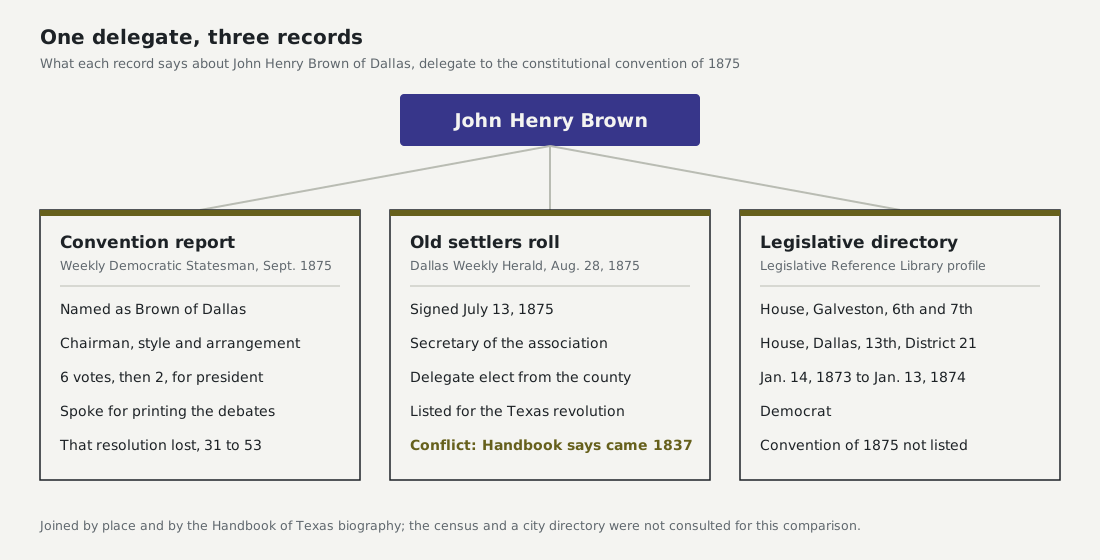
Brown was on the losing side of that choice. A week later the Statesman reported the debate over employing a stenographer and printing the debates. Brown told the convention he favored retrenchment and reform as far as reason and common sense dictated and no further, that he wanted his people kept posted, and that he had “no desire to hide his actions from them.” The resolution failed, 31 to 53, and the paper notes that Brown was in the chair for part of the voting that day.3 The delegate who wanted the record kept is the one I now have to reconstruct from a newspaper.
What the proceedings record
Read together, the Statesman’s reports give a working picture of the man in the hall. On the opening days he offered the resolution under which the members took their oath, and he was nominated for president of the convention. He drew 6 votes on the first ballot and 2 on the second, when Edward B. Pickett was elected with 43.4 He was named to the committee that proposed the list of standing committees.4 He moved that county seats be the points from which distances to the capital were measured for mileage, which made the county seat the unit of distance, a theme picked up again in county government after 1876.1
The reports also show how names were kept apart. The same committee list carries a Russell of Wood and a Russell of Harrison, and a Henry of Smith beside a J. R. Henry.1 Reporters added a county when a surname was not enough. Brown of Dallas is that habit at work, and I have not established whether another Brown sat in the hall.
A roll signed in July
The second record came from Dallas a few weeks earlier. On August 28, 1875, the Dallas Weekly Herald printed the constitution and membership of an association of early settlers organized in the county, signed on July 13, 1875. Membership was open to men who had served Texas against Indians and Mexicans before annexation, to veterans of the Mexican War, and to their wives. The officers elected included Major John Henry Brown as secretary, and his own line on the roll reads, as the scan gives it, Texas revolution, and captain in the Texas Indian war.5 The same issue calls him the delegate elect from the county to the convention.5
On its front page the same issue lists the members of earlier Texas conventions who had been elected to the new one. Of the delegates to the secession convention of 1861, it counts eight, John Henry Brown of Dallas first among them.6 The Handbook of Texas says that eight members of the 1875 convention had sat in the secession convention, and that Brown chaired the committee there that prepared the articles of secession.27 Two independent sources agree on a count, which is the kind of agreement I value most.
The legislature’s directory of members
The third record is the one I would have trusted without thinking twice, and it taught me the most. The Legislative Reference Library’s directory of legislators has a profile for John Henry Brown with his birth and death dates. It lists three terms in the House: two from Galveston in the 1850s, and one from Dallas, District 21, as a Democrat, from January 14, 1873, to January 13, 1874, in the Thirteenth Legislature.8 Its notes credit, among other sources, an 1857 Austin newspaper list of members elect found through the Portal to Texas History, and they admit that the date of his resignation from the Seventh Legislature is unknown.8
What the directory does not list is the convention. It is a directory of legislators, and the convention was not a legislature. Anyone who stopped at the profile would conclude that Brown’s public service ended in January 1874.
Where the three records agree and part
My rule for joining records is stricter than name and place. Two records describe the same man only when they share a fact that could not easily belong to anyone else. For Brown the joins are clear. The Herald’s delegate elect from Dallas, the Statesman’s Brown of Dallas and the directory’s representative from Dallas in the Thirteenth Legislature are tied by the secession convention count and by the Handbook’s account of a man who settled in Dallas in the early 1870s, was elected to the legislature in 1872 and joined the convention three years later.7
A genealogist would tell me I am too cautious, that a distinctive full name in one county in one year is identification enough, and on most days that is true. I hold to the stricter rule because the cost of a false join is invisible. A wrong man merged into a biography does not announce himself. He simply adds a fact nobody checks.
The roll is where the records part. The Handbook says Brown moved to Texas in November 1837, after the revolution was over, and fought in the battle of Plum Creek in August 1840.7 A line crediting him with service in the Texas revolution does not fit that chronology. The association’s own rule explains why it hardly mattered at the signing: service against Indians before annexation qualified him on its own. I take the roll as a record of how the men of 1875 wished to be listed, and I would not cite it for his arrival date.
What I would not claim
Three things stay outside this essay. I have not read the federal census for Brown’s Dallas household, and I have not found him in a city directory of the period, so the two records I most often use to fix a man at an address are missing here. And I cannot see his words except through reporters, some of whom shared his politics and used his side’s vocabulary, the problem taken up in the essay on the word redemption. What Brown and his colleagues produced is set out article by article in the 1876 constitution’s reference page. Any roll of names deserves the same suspicion, whether a settlers’ association kept it or a registrar did, as with the lists of 1867.
This is the method that sat underneath my biography of Coke, applied to a man the book does not follow, and the companion studies are gathered under Reconstruction. Brown went on to serve as mayor of Dallas and to write a history of Dallas County, and his papers are at the Briscoe Center.7 Those papers would be the next place to test every line above.
On the printout from September 16, my margin note beside Brown of Dallas now reads three sources, two joins, one conflict. It is the most useful line on the page.
References
-
The Weekly Democratic Statesman (Austin, Tex.), September 16, 1875, page two, Chronicling America, Library of Congress, The weekly democratic statesman, September 16, 1875. ↩ ↩2 ↩3
-
Handbook of Texas Online, Texas State Historical Association, Constitutional Convention of 1875. ↩ ↩2
-
The Weekly Democratic Statesman (Austin, Tex.), September 23, 1875, page two, Chronicling America, Library of Congress, The weekly democratic statesman, September 23, 1875. ↩
-
The Weekly Democratic Statesman (Austin, Tex.), September 9, 1875, page three, Chronicling America, Library of Congress, The weekly democratic statesman, September 9, 1875. ↩ ↩2
-
The Dallas Weekly Herald (Dallas, Tex.), August 28, 1875, page two, Chronicling America, Library of Congress, The Dallas weekly herald, August 28, 1875, page two. ↩ ↩2
-
The Dallas Weekly Herald (Dallas, Tex.), August 28, 1875, page one, Chronicling America, Library of Congress, The Dallas weekly herald, August 28, 1875, page one. ↩
-
Handbook of Texas Online, Texas State Historical Association, Brown, John Henry. ↩ ↩2 ↩3 ↩4
-
Legislative Reference Library of Texas, Texas Legislators, Past and Present, John Henry Brown. ↩ ↩2