Out of eighteen, eight. A Dallas County commissioner named Witt gave that figure to a meeting of citizens at Firemen’s Hall on March 2, 1878: of the eighteen road overseers in his district, only eight had reported. The city papers had been blaming the commissioners, he said, but the court had no control over the overseers and could only report them to the grand jury.1 The Herald’s account does not say whether the hall went quiet at that point. I suspect it did, because the commissioner had just told a roomful of taxpayers that the body they held responsible for their roads could not make anyone work on them.
That one paragraph is the best short description I know of county government after 1876, and the research problem it raises is simple to state. What was the commissioners court, and how can a reader tell what it actually did?
The court that heard no cases
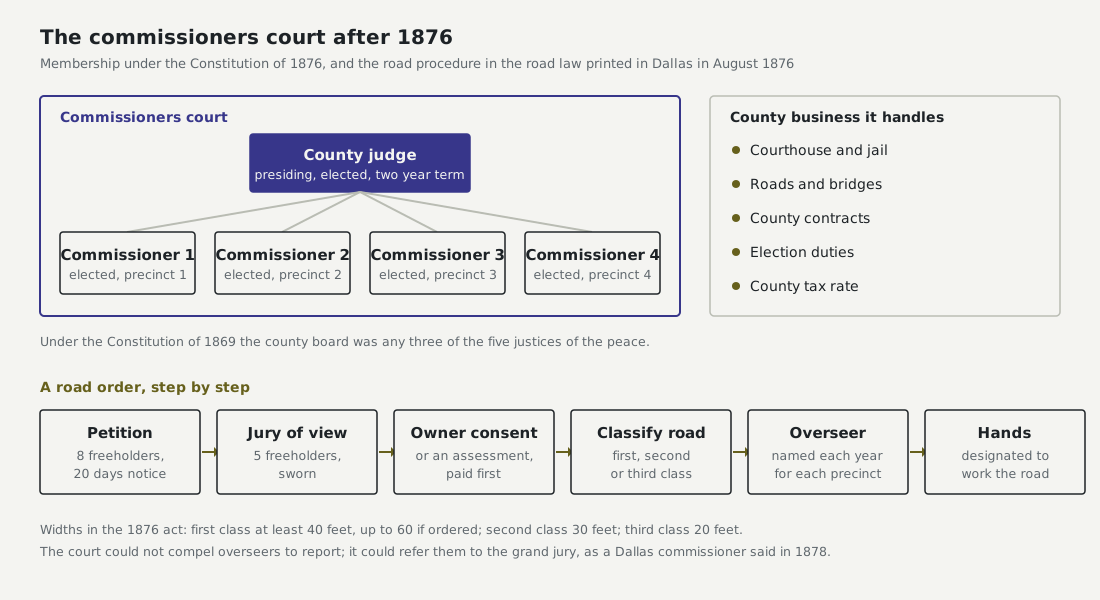
Start with the structure, because it changed more than once in a generation. Under the Republic the county board was the chief justice and the justices of the peace. Under the constitutions of 1845, 1861 and 1866 it was the chief justice and four elected commissioners. Under the Constitution of 1869 it was any three of the county’s five justices of the peace. The Constitution of 1876 settled on a county judge as presiding officer and four commissioners elected from precincts for two year terms.2 The office of county judge itself had been abolished in 1869 and was restored in 1876 as an elective post with a two year term.3 That arrangement is one clause among many in the 1876 charter.
The name misleads nearly everyone the first time. The Handbook of Texas puts it bluntly: the commissioners court has none of the functions of a court and is the general governing body of the county. Its list of duties runs from establishing the courthouse and jail to letting contracts, building and maintaining roads and bridges, handling election duties and setting the county tax rate.2 The courthouse housed the state’s courts and the county’s business under one roof,4 a pairing the entry on Texas county courthouses follows through the buildings themselves.
The best way I have found to see the court at work is through the road law. In August 1876 the Dallas Daily Herald printed the new act regulating the laying out, opening, classifying and working of public roads, section by section.5 Read as a document, it is a procedure manual for the commissioners court’s most constant business.
The sequence goes like this. At least eight freeholders of a road precinct had to petition the court, after posting notice for twenty days at the courthouse door and at two other public places near the route. The court appointed a jury of view, five freeholders sworn to lay out the road according to law and without favor or ill will. No road could cross a farm or enclosure without the owner’s written consent; if consent was refused, the court appointed five disinterested freeholders to assess what the owner was owed, and the county paid it before the road was opened. Then the court classified the road, appointed an overseer and assigned the hands who would work it.5
The classes were set down to the foot. A first class road was to be at least forty feet wide and could be ordered as wide as sixty, a second class road thirty and a third class road twenty, with stumps cut to a fixed height and causeways of fixed width.5 At its first regular meeting each year the court divided the county into road precincts, named an overseer for each and designated the men liable to work under him.5 The Handbook adds that able bodied men between eighteen and forty five were generally required to give several days a year to road work, and that landowners could pay substitutes.6
A historian of Texas politics could push back on my view here. For most rural Texans after 1876, the commissioners court’s road order was the most direct contact they had with government, closer than any statute from Austin and more personal than a tax receipt. It told a man which days he owed, to which overseer, on which stretch of road. The objection is that I am mistaking frequency for importance, and that taxation, schooling and the courts upstairs shaped lives more deeply than a few days with a shovel. That may be so. But the road order is the one place in the county record where government reached a farmer by name and asked for his labor.
The record has limits I cannot get past. A printed act tells me what the court was allowed to do. The minutes, where they survive, tell me what it ordered. Neither tells me whether the road was built. Commissioner Witt’s figure is the gap in miniature: an overseer who never reported leaves no trace of the work he did or did not do.1 A Dallas paper had asked the year before whether the county commissioners, the road overseers or anyone at all would repair a bridge on a county road, which suggests the public was as unsure as I am about where responsibility sat.7
The sources also disagree in small ways that matter. The Handbook gives the old third class road a width of twenty two feet, while the act the Herald printed says twenty.65 I have not established whether the Handbook describes an earlier statute or whether one of the two carries an error. I report both and do not choose.
Tracing any one of these commissioners runs into the same trouble I describe in following a single delegate through three records, and the presiding justices of the older system turn up during a tense January in my reading of the 1874 telegrams. Local records of this kind are close to my own work with local history, and road rolls have a flaw in common with the registration books of 1867: each names whoever the system caught and stays silent about everyone it did not. Other county and state records from these years appear across the Reconstruction pages.
What the record still cannot say is the thing the citizens at Firemen’s Hall wanted to know: how many miles of Dallas County road were actually worked in the winter of 1878, and by whom.
References
-
The Dallas Daily Herald (Dallas, Tex.), March 3, 1878, page one, Chronicling America, Library of Congress, The Dallas daily herald, March 3, 1878. ↩ ↩2
-
Handbook of Texas Online, Texas State Historical Association, County Commissioners Court. ↩ ↩2
-
Handbook of Texas Online, Texas State Historical Association, County Judge. ↩
-
Handbook of Texas Online, Texas State Historical Association, County Courthouses. ↩
-
The Dallas Daily Herald (Dallas, Tex.), August 18, 1876, page two, Chronicling America, Library of Congress, The Dallas daily herald, August 18, 1876. ↩ ↩2 ↩3 ↩4 ↩5
-
Handbook of Texas Online, Texas State Historical Association, Highway Development. ↩ ↩2
-
The Dallas Daily Herald (Dallas, Tex.), January 11, 1877, page four, Chronicling America, Library of Congress, The Dallas daily herald, January 11, 1877. ↩