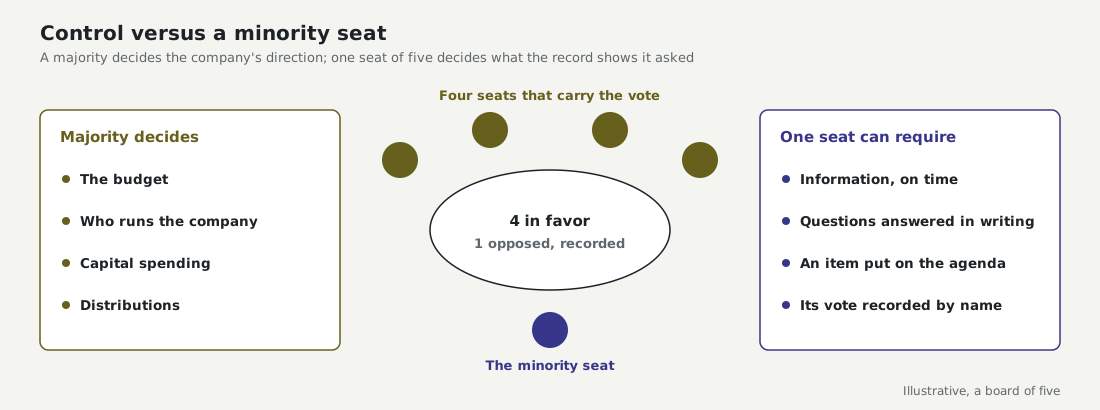
“Four in favor, one opposed.” The company secretary read the tally aloud, looked up, and asked whether I wanted my vote recorded by name. It was the only no of the meeting and, as it turned out, the only one I cast on that board in several years. I said yes. The chief executive, who had carried the item comfortably, wrote something on his pad and did not look at me for the rest of the afternoon.
That tally is the number that defines a minority seat. Four to one, or three to two, the arithmetic of a board where the director you are does not control the outcome. Everyone at the table knows it before the meeting starts. The interesting question is what the one seat is for, given that it will lose any vote it takes on its own.
My answer is that a director without control has one dependable instrument, and it is the record. He cannot direct management. He can make sure that what the board was told, what it asked, and what it decided are written down in a form that someone reading the minutes in three years will understand. Most of the influence a minority director has flows from that. Management teams behave differently toward a question they know will be minuted, and a board that sees its own reasoning in writing reasons more carefully the next time.
What the seat can require
The list of what a single director can properly ask of a management team is shorter than new directors expect, and firmer. He can ask for information, and for it on time. He can ask that a question be answered in the room or in writing before the next meeting. He can ask that a matter be put on the agenda. He can ask that his view be recorded. Each of those is a request that a well run board grants to any member regardless of how many shares stand behind the seat.
What he cannot ask for is equally clear. He cannot tell the chief executive whom to hire, which customer to chase or which crew to move. He cannot rewrite the budget. He cannot run a side channel to the controller and call it oversight. The temptation for a minority director who feels unheard is to reach for those things informally, and it is the fastest way to lose the standing the formal tools depend on.
Inside those limits the useful requests are specific. I ask for the monthly cash history, which tells me more about a company’s year than any plan, as the essay on seasonality as a financing problem explains. I ask what the questions would be if a strategic buyer walked in tomorrow, because a larger competitor reads a company differently from an investor, as I discuss in selling to a larger competitor. I ask about records that exist outside the company. Drilling and completion work in this state is subject to statewide requirements for casing, cementing, well control and completion set by the Railroad Commission of Texas,1 and whether a company’s crews know those rules is a question any director may put.
The commission itself is a small lesson in minority seats. In 1894 the legislature made it elective, with three commissioners on six year overlapping terms,2 and it still has three.1 A body of three has a minority of one whenever it divides, and the one learns to write things down.
Other experienced directors resist what comes next. I think a minority director should, rarely and deliberately, ask for a dissent to be recorded by name, and that a board whose minutes show nothing but unanimity for five years has either been very lucky or has stopped recording what it actually thinks. The standard view is that a private company board should settle disagreement before the vote and present one face, and that a named no poisons the relationship with management for a quarter or more. It often does. I have watched a chief executive treat a recorded dissent as a personal insult, and I have been that dissenter.
I have also been wrong. Some years before that four to one vote I recorded a no against a senior hire I thought was too expensive and too green. He turned out to be the best operator the company had, and my name sat in the minutes against him for as long as he was there. He never mentioned it. He did not need to. That is the cost of the instrument, and it is why I spend it so rarely: a named dissent is permanent, and so is a mistaken one.
The four to one vote was different. The item was a distribution to shareholders, to be drawn on the revolving line three months before the company’s slow season, and I believed the board was spending the cushion it would need in January. I said so, lost, and asked for the record. The slow season came. The company got through it, narrowly, and in the meeting that followed the chief executive asked that the board revisit its distribution policy, citing the minutes.
The capital behind a minority seat is usually growth equity, which by nature buys influence without command. I learned early in my career in energy finance that the paper trail outlasts the argument, and older Texas records, such as those behind a history of Dallas oil wealth, say the same. The idea recurs across the energy section of this site.
I would ask for my name to be recorded again. The vote was lost the day it was taken, and the record did its work six months later, which is the only schedule a minority seat ever gets.
References
-
Railroad Commission of Texas, Oil and Gas Compliance and Enforcement ↩ ↩2
-
Texas State Historical Association, Handbook of Texas, Railroad Commission ↩