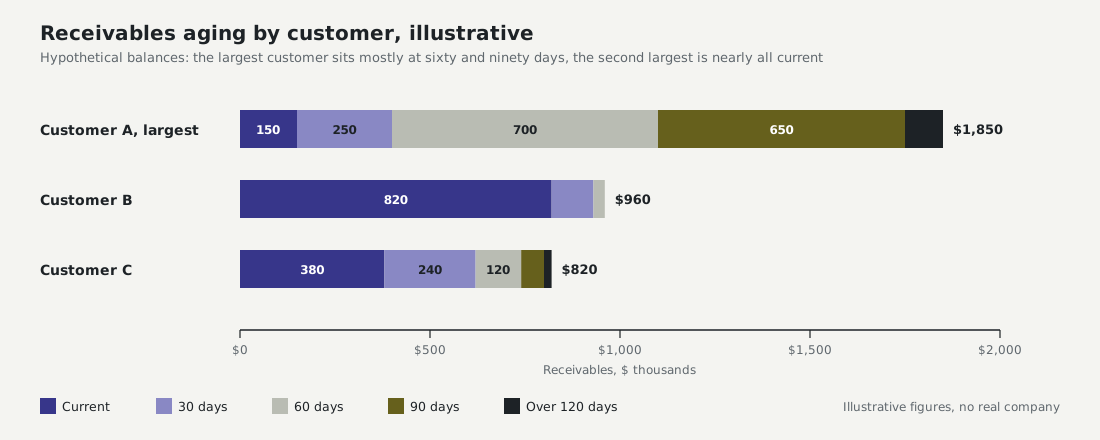
The aging report was the one page in the packet that nobody had dressed up. It came straight out of the accounting system: customers down the left margin, five columns across for current, thirty, sixty, ninety and over one hundred twenty days, a total at the bottom, and a staple in the corner. I have learned to read the stapled page before the pretty ones.
The chief financial officer covered it in about a minute: totals a little higher, average days outstanding close to last year, reserve unchanged. Then one of the other directors put his finger on the top line. The largest customer, roughly a third of the company’s revenue, had almost nothing in the current column and most of its balance sitting at sixty and ninety days. The second largest, a smaller operator, was nearly all current.
Nobody spoke for a moment. Then the chief executive said the big one always paid, which was true, and which was the whole problem. It paid when it chose to. The smaller operator paid in about a month because this company had once held a crew in the yard until an old invoice cleared, and the operator remembered. Two customers, the same contract terms on paper, and two completely different answers to the question of who was in charge.
That meeting settled something I had half believed for years. A receivables aging report gets filed as a credit document, a list of who might fail to pay. In a service company it is far more useful read as a ranking of power. The days an operator takes beyond the contract are days the service company has agreed, without ever saying so, to lend that operator money. A customer that pays late and suffers no consequence is telling you plainly who holds the stronger hand.
What the columns are really counting
The first thing to understand is that days outstanding are two numbers added together, and only one of them belongs to the customer.
The clock starts when a crew finishes a job. A field ticket has to be written, signed by the operator’s representative on location, coded to the right well and cost account, invoiced and loaded into the operator’s approval portal. Every one of those steps happens on the service company’s side, and every one can stall. Only after the invoice is accepted does the operator’s own payables schedule begin.
So when I see a large balance at ninety days, I ask for it split in two: the days from job completion to an accepted invoice, and the days from acceptance to cash. The first number is about the company’s own discipline. The second is about the relationship. Blending them hides both.
The second number is the one that shows power. Take a hypothetical company billing $12 million a year to its largest operator, with contract terms of thirty days and actual payment at about seventy five after acceptance. Those extra forty five days are worth roughly $1.5 million of the company’s money sitting in the customer’s account at any moment, interest free, extended by a business with a fraction of the customer’s balance sheet. Nobody approved that loan.
In oilfield services the vendor is almost always the smaller party, and that imbalance is normal in the trade. What varies is how much of it a company accepts without looking. Outside money makes the question sharper, because growth equity put into a service company to add crews can end up, quietly, financing its customers’ payables instead. No investment memo I have ever read proposed that use.
The price includes the payment days
My own view, which capable directors dispute, runs as follows. A service company should treat each customer’s actual payment history as part of the price of the work, and a board should be willing to see its largest slow payer’s share of revenue shrink rather than keep financing it.
The opposing case is strong. The operators with the biggest programs are exactly the ones who will not change their payables practices for a small vendor, and a company that pushes back risks losing the volume that keeps its crews busy. An idle crew costs more in a month than slow money costs in a quarter. On that view, carrying a large customer is simply what it costs to have one, and a director who wants to discipline the relationship is pricing the wrong risk.
I take that seriously, and in some years it wins. But I am rarely asking a company to walk away, only to know the price. When management can see that one customer’s work carries $1.5 million of free credit, the choices get specific: a higher rate on the next bid, a discount for payment inside thirty days, a rule that the next new crew goes to the customer who pays on time. None of them can be made by a team that reads its aging report as a list of bad debts.
The report also moves before anything else does. When a customer that paid in forty days starts paying in seventy, something changed on its side, and there are only a few possibilities. It installed a new payables system, it is short of cash, or it has decided your company is easy to replace. Operator activity in this state is public in a way most private businesses are not. The Railroad Commission of Texas publishes drilling permit data and monthly summaries of drilling, completion and plugging.1 A customer whose payments are slowing while its permits hold steady is making a choice about you. One whose activity is falling too is making a choice about itself. Those two situations call for opposite conversations, and the aging report is usually where a board first sees the difference.
It is one of the pages I ask for early in my board work, and it is the first page I ask about when a company buys another one, because the acquired book arrives with its own payment habits, a point I come back to in the essay on why an add on acquisition doubles the work. Who waits for whom is an old question in Texas oil, and the bankers in the essay on Dallas and its oil money would have known this page well.
Where I read the page wrong
On one board, a while back, an operator’s balance had drifted steadily toward ninety days. I read it as power. I pressed the chief executive for two meetings running to confront the customer, tighten the terms, and move a crew if nothing changed. I took his reluctance for the usual reluctance of a vendor to annoy his biggest account.
The delay was ours. A new field supervisor had been writing tickets without the operator’s cost code, and the operator’s payables group was rejecting them without comment. The invoices never reached the schedule I was angry about. The fix was one afternoon with a clerk and a corrected template. Had the chief executive done what I asked, he would have picked a fight with a customer who had done nothing wrong, on my instruction, and I would have been the director who caused it.
That is why I now insist on the split between days before acceptance and days after. It is also why I hold the rule with less confidence than I did. The aging report shows who is waiting on whom. It does not show why, and it cannot tell a young company with one dominant customer that it has any choice at all. Sometimes the honest reading is that the customer holds the power and will keep it, and the only decision left is how much cash to hold against that fact.
Like much of the energy writing on this site, this ends on a limit. Receivables show who holds the power in each relationship, and they stop there; whether a company can afford to take any of that power back is a judgment the report will never make for it.
References
-
Railroad Commission of Texas, Oil and Gas Research and Statistics ↩