On the fourteenth of a March some years ago, a white pickup stood at the back fence of a service company’s yard with its passenger door pushed in and a strip of red tape across the cracked mirror. I did not see the truck that day. I saw it about eight months later, as one line in a loss run: automobile physical damage, date of loss in March, paid a little over $8,000, closed. When I finally walked that yard, the truck was back in service and the door had been replaced, a slightly different shade of white from the rest of the cab.
A loss run is the insurance carrier’s list of every claim filed under a policy, open and closed, with the date, the type, what has been paid and what is still held in reserve. I ask for five years of them in the first week of looking at a company, before I have built a view of the numbers and well before anyone is talking about price. Plenty of experienced people think that is the wrong order, and their case deserves to be put properly.
The case for leaving it to the specialists
The argument runs like this. Insurance is a specialist subject, placed and priced by agents and underwriters who read loss runs for a living. An investor reading them in the first week is doing an amateur version of a professional job, months before the professionals would look anyway. Worse, a small company’s claims history is statistically thin. Forty employees and twenty trucks produce a handful of claims a year, and one bad week can make a careful company look reckless. Drawing conclusions from that sample is reading tea leaves.
There is a relationship cost too. An owner who has run a company for twenty years hears a request for five years of claims as an accusation, and early in a process the owner is still deciding whether he wants a partner at all. A director I respect once told me that asking for loss runs before a letter of intent is like asking to see a man’s medical records before you have had lunch with him. Better to wait, he said, let the insurance agent handle it in confirmatory diligence, and spend the early weeks on customers and crews.
I agree with more of that than my habit suggests. The specialists do read the file better than I do. The sample is small. And in a competitive process, being the only party asking awkward questions early can cost a place at the table.
What the file says that nobody else will
What moves me anyway is my reason for reading the file, which has little to do with pricing insurance. The loss run is the one history of the company’s field work written by somebody with no reason to make it look good. The management presentation is written to persuade. The safety slides are written by the safety department. The claims in it are entered by adjusters who work for the carrier, recording what happened on dates they did not choose, and it will say the same thing to me that it says to the renewal underwriter.
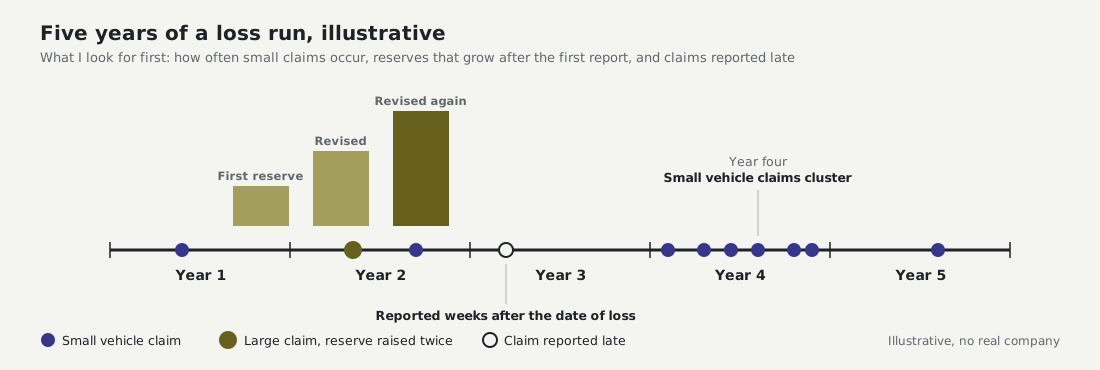
Three things in it tell me more than anything else in the early files. The first is frequency of small vehicle claims. A cluster of minor truck damage in one year usually means drivers were running long hours, which usually means dispatch was stretched, which is a question about growth and management depth that no income statement will raise. The second is reserves that grew after the first report. A claim booked at one figure and revised upward twice tells me the company did not understand, at the time, how serious an incident was, and I want to know why. The third is the gap between the date of loss and the date the claim was reported. A company that reports within days has a field culture that tells the office things. One that reports weeks later has a field culture that hopes things go away.
Serious incidents also leave a trail outside the insurance file. The Railroad Commission of Texas, whose importance despite its name has rested on its authority over the energy industry,1 keeps a round the clock line for reporting fires, leaks, spills and breaks in oil and gas activity.2 The commission also sets statewide requirements for casing, cementing, drilling, well control and completion, the work where the worst days in the field begin.3 When a claim in the loss run lines up with an event that a regulator would have heard about, I read both. The commission’s own long history is set out in the entry on the Railroad Commission of Texas, and it is a useful reminder that the public record in this business is older and deeper than most owners assume.
The file also matters after closing. Two insurance programs are among the first things that have to be reconciled when one company absorbs another, and a buyer who has read the other company’s loss runs knows which program to keep. In the companies I have looked at, claims bunch up in the busiest and coldest weeks of the year, which is one more reason I think seasonality is a financing problem first.
Where does my rule break? A clean loss run proves less than it appears to. Some owners pay small claims out of pocket to protect their premiums, and a file with nothing in it can mean a careful company or a company that settles its dents in cash. I read one of those as a sign of discipline once and later learned the owner had been paying for truck repairs out of the shop budget for years. The file could not show me what was never filed, and I had treated its silence as evidence. I still ask for five years, but I now ask for the shop’s parts and repair ledger alongside it, and when the two disagree I believe the ledger.
The objection about thin samples also stands. One bad year in a small oilfield services company can be bad luck, and I have argued with myself about more than one file where I could not tell. The loss run raises the question. It rarely answers it.
What I have kept from a long career in energy finance is a bias toward records whose authors had nothing to prove. Most of the records a company hands an investor were produced for the purpose of being read by one. The loss run was produced to settle claims, which is why I read it before the others. That bias runs through the rest of the energy series, and through my reading of older Texas records, including those behind the essay on Dallas and oil money.
The pickup with the replaced door is probably still working somewhere, and nobody who sees it would know what happened on that day in March. The loss run knows. It is still sitting in a file with the date, the amount and the word closed, which is exactly why I asked for it first.
References
-
Texas State Historical Association, Handbook of Texas, Railroad Commission ↩
-
Railroad Commission of Texas, Accidents and Incident Reporting ↩
-
Railroad Commission of Texas, Oil and Gas Compliance and Enforcement ↩