The plan of Austin is simple enough to hold in memory once it has been unrolled a single time. A grid fourteen blocks square, split down the middle by Congress Avenue, runs north from the Colorado River to Capitol Square.1 I keep a copy beside me whenever I look at photographs of the town, because nearly every street view from the nineteenth century was taken somewhere along that one spine, and the first question about any of them is where the camera stood.
The plan and the frame
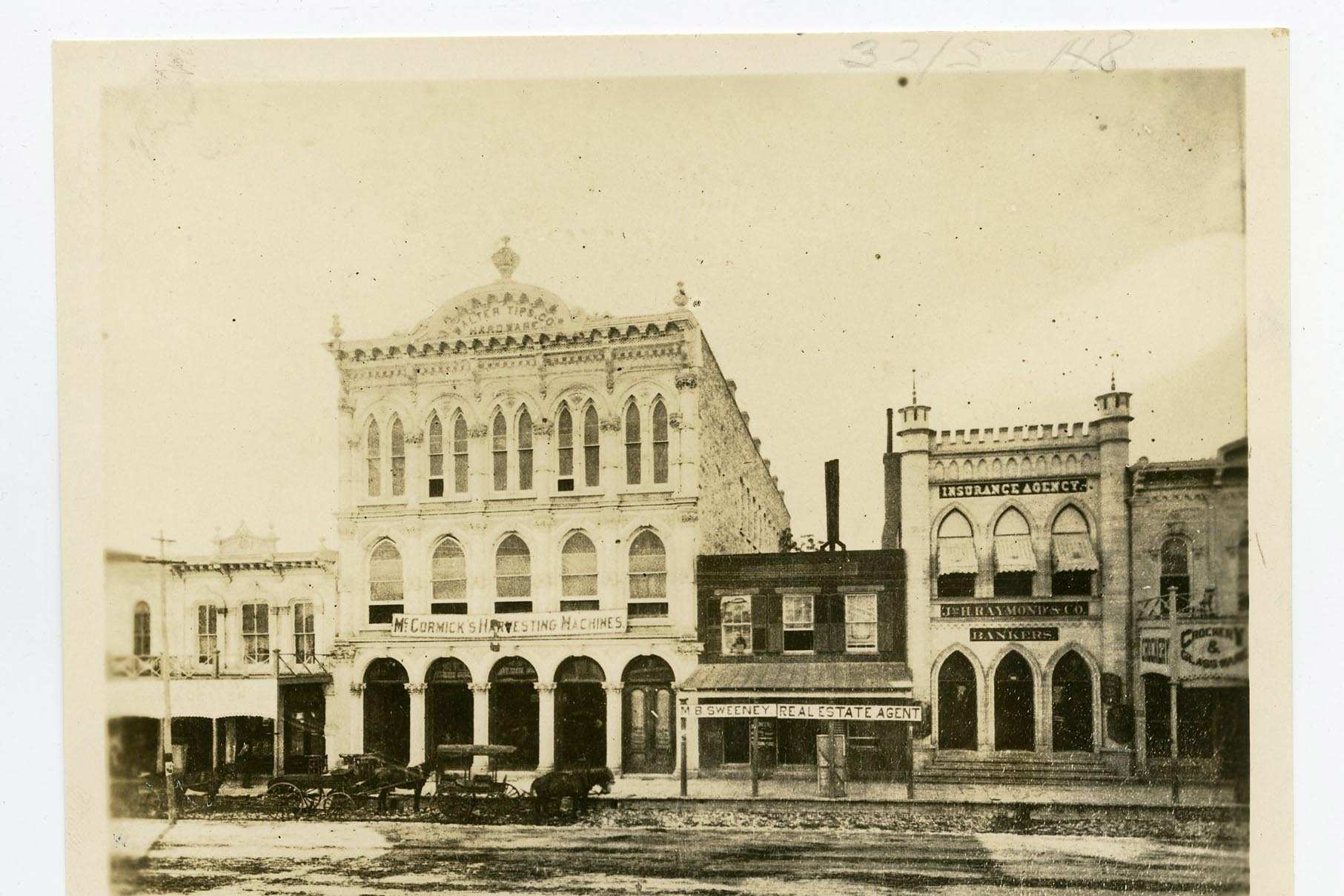
The photograph above is catalogued as a view of Congress Avenue. It shows a row of commercial fronts: a tall ornamented building with a banner for McCormick’s harvesting machines, a small brick shop for a real estate agent, a crenellated front lettered for an insurance agency and a banking house, and a crockery and glassware store at the edge. Wagons stand at the curb. The street is dirt, and rails run through it.
Each of those signs is a lead. A city directory or a newspaper advertisement could put a name to a block and a year, and the plan would then tell me which side of the avenue I am looking at. I have not yet done that work for this print, and the essay would be dishonest if it pretended otherwise. What I can do without it is test the caption.
What the caption claims
The words filed with the picture, reproduced in the credit below it, make three claims in a single line: the place is Congress Avenue, the photographer is S.B. Hill, and the year is 1881. The catalog adds a fourth, giving Hill’s life as 1840 to 1917. A pencilled number on the mount matches the item number in the record, which tells me the print and the catalog entry belong together. It does not tell me who first wrote the caption, or when.
I treat a caption as a separate document with an unknown author and an unknown date. It may have been written by Hill on the day, by the person who pasted the print into a scrapbook, or by a cataloger generations later working from memory or a guess. Each of those writers knew a different amount. The picture, by contrast, was made once, by light, at a single moment, and it can only show what stood in front of the lens.
The fourth claim is the easiest to check, and it does not survive the check. The Handbook of Texas says that conflicting records place Hill’s birth in 1839, 1841 or 1843.2 The catalog’s 1840 is none of the three. I do not know where it came from, and that uncertainty is instructive about the others. If a birth year can drift in a catalog heading, so can a date in a title.
Bracketing the picture
My method is to let the frame set limits and to see whether the caption falls inside them. Anything in the picture that did not exist before a known year sets a floor. Anything that was gone after a known year sets a ceiling. The caption’s date is credible only between the two.
The rails give a floor. Austin’s first streetcar line opened in 1875, the same decade the city put up gas street lamps.1 If those are streetcar rails, and the Handbook’s account of Hill’s work describes his views of the avenue as showing trolley tracks, the picture was made in 1875 or later.2
The attribution gives a second floor, and it depends on believing the caption. Hill moved his family to Austin in 1877. The partnership that probably began his career in photography advertised in an Austin paper in 1878, and by 1879 he had a studio of his own on Congress Avenue.2 If Hill made this picture, it is no older than about 1878. The Handbook adds that he was experimenting with dry plates by 1882, and that his photographs of the unpaved avenue survive in several Austin collections, including the state library’s.2
I have found no ceiling in the frame. Nothing visible in it ceased to exist in a year I can document from a source I trust. So the honest statement is that the picture was made no earlier than 1875, and, if the attribution holds, no earlier than 1878. The year 1881 sits comfortably inside that range. It is plausible. It is not proven.
Where the bracket fails
I hold to one practice here that many researchers would call excessive. When I cite a photograph like this one, I cite it as attributed and as dated by the catalog, and I say so in the note, even when the date is probably right. A colleague would answer that the archive has handled the collection for decades, that its date is the best available, and that qualifying every caption makes a book unreadable. The answer has force. My reply is that a reader cannot see the difference between a date the image supports and a date someone typed, and the note is the only place I can show it.
The method has real limits. Floors are easy and ceilings are hard, because the frame shows what existed and rarely what had vanished. A single demolished building, dated from a newspaper, would give me the ceiling I lack. The same weakness appears when a caption is simply transferred into a scan, a problem taken up in what a digitized page loses. Maps have their own version of it, discussed in the essay on land office maps, and one digital library that puts Texas pictures online is described in the entry on the Portal to Texas History.
Bracketing of this kind was a daily habit while I worked on my book on Coke, and it is the same test I put to the people in tracing a delegate through three records, whether the witness is a street or a ledger, and more of it is gathered in the archives hub. Of every number attached to this print, the date, the birth year and the item number, only one comes from the picture itself: the rails in the street, and the year 1875 that they carry.
References
-
Handbook of Texas Online, Texas State Historical Association, Austin, TX (Travis County). ↩ ↩2
-
Handbook of Texas Online, Texas State Historical Association, Hill, Samuel B.. ↩ ↩2 ↩3 ↩4