The first call I make about any document that will carry weight in my writing goes to the reading room that holds it, and the question I ask has not changed in years. What was the image I am looking at made from? The answer is one of three things: the paper itself, a microfilm of the paper, or a copy of the film. Most of the time the person on the line can tell me. Sometimes nobody knows, and that answer is the most useful of the three, because it tells me how carefully to read.
The document I use to explain why is one the state library calls probably the best known of all Texas documents.1 On February 24, 1836, the second day of the siege, William Barret Travis wrote from the Alamo calling for reinforcements.2 The letter is held by the Texas State Library and Archives Commission, and its online exhibit presents it as a short essay, four numbered pages and a full transcription.2 On a screen it is a clean sequence: page one, page two, page three, page four.
The paper did not live that way. Captain Albert Martin of Gonzales carried the letter out of the Alamo. The next day, riding toward home, he heard artillery in the distance and, at the first chance, added a postscript of his own. At Gonzales he handed the dispatch to Lancelot Smither, who wrote a further note on the back of the letter before carrying it on toward San Felipe.2 So the object is the work of three men, writing at three places over roughly two days, in whatever order the paper allowed. After the war it went back to the Travis family, reached a state department on loan in 1891, and was bought in 1893. By 1903 it was on exhibition in the main room of the State Library, and in 1936 it left the agency’s care, lent with 142 other documents to the Texas Centennial exposition.2
Every one of those events happened to physical paper. A ride to Gonzales, a hurried postscript, a note on the reverse, decades in a family’s keeping, years under glass: each leaves something on paper, and almost none of it survives the camera as evidence. A scan records what was on each surface at the moment it was made. It flattens the rest into four rectangles of equal standing, numbered by the exhibit, and the order of the numbers begins to feel like the order of the writing.
I do not know, from the images, how the four faces relate to one another as paper, which surface Smither chose, or what the paper looks like folded. The transcription settles the words. The images settle the hands. The object would settle the sequence and the handling, and I have not stood over it. That is the gap I mean, and it is the gap anyone working from a screen should admit in a note.
Three generations of one image
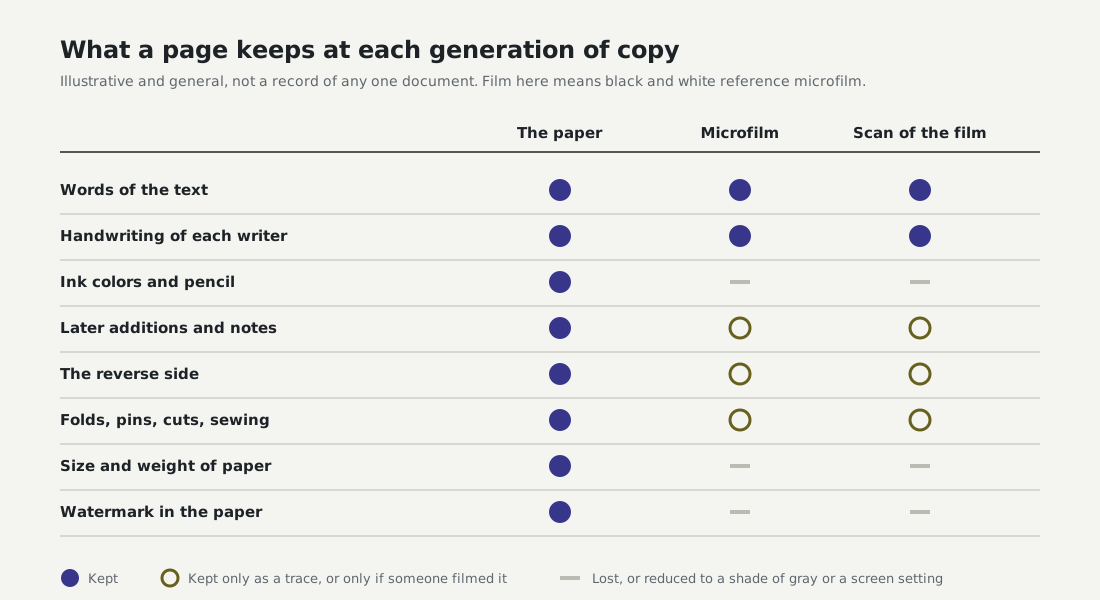
I have not asked what the Travis images were made from, which is itself a small lapse. For much of what I read, the answer is on record. The state archives say plainly that the voter registration lists of 1867 to 1870, which I discuss in the essay on those ledgers, were digitized from reference microfilm copies.3 The image on my screen is a scan of a film of a page. Each step kept the words and discarded something else, and the discards compound.
The University of North Texas records a similar history for newspapers on the Portal to Texas History. In 2010 it bought a scanner so that it could digitize newspapers from microfilm in house. In 2013 it bought a planetary scanner to capture physical newspapers in full color, and the first paper done on it was the Meridian Tribune.4 The digital library described in the entry on the Portal therefore holds pages made both ways, and two images of the same county’s news may be different generations of copy sitting side by side in one set of results.
What changes between generations is predictable, and none of it is the text. Color goes first. A film records tone, so a later addition in a different ink, a correction in pencil, a stamp in red, all become the same gray as the words around them, and the record of who wrote when goes with the color. The reverse of a sheet may not have been filmed at all, or may appear as a separate frame far from its front. Show through from the other side can look like marks on this one. Paper that was folded, cut, pinned or sewn shows only the result, not the operation. Size becomes a setting on a screen. A watermark, visible only when a sheet is held to the light, rarely reaches a copy made from film, and I would not rely on finding one in any scan I had not asked about specifically.
The pictures raise the same problem in a different register. A photograph reproduced online carries its caption as if the words were part of the image, a problem I describe in the essay on captions. A scan carries its catalog record the same way. The metadata and the image arrive together and look equally old.
Here is the position I would defend against many archivists. I would give up a share of the next million digitized pages in exchange for one line on every existing image stating what it was made from, paper or film, and when. The counterargument is strong and I have heard it well made: access is the whole point, the public benefits more from new pages than from notes on old ones, and a careful researcher can always ask. My answer is that most researchers never ask, because the image gives no sign that there is anything to ask about. A scan that looks complete teaches its readers not to wonder.
My own practice has not always met that standard. For years I wrote about the page when what I had read was a film image of the page, and I did not say so. Nothing I published turned on the difference, as far as I know. That last clause is the problem. I would not know, because the evidence that might have contradicted me was exactly the evidence the copy had dropped.
Nor is the answer always to go to the original. Some originals are too fragile to handle, and the archives keep a conservation lab for a reason.5 Some would add nothing, because the question is about words and the words are clear. And a working investor who writes history on his own time cannot sit in every reading room that holds a document he cites. The research behind my biography of Coke leaned on digitized copies far more than on trips to reading rooms, as the method in tracing a delegate through three records makes plain. What I can do is keep a record of which generation I read and say so when it matters.
The next essay turns to a record type that makes the problem sharper, since the evidence in family Bibles and private registers often lies in the ink and the hand as much as the words; the rest are gathered on the archives page. The limit is simple to state. A scan tells me what a page said on the day it was photographed. It cannot tell me what the paper went through, in what order the marks arrived, or what was on the side nobody filmed, and anything I claim about those matters from a screen is a guess.
References
-
Texas State Library and Archives Commission, The Battle of the Alamo. ↩
-
Texas State Library and Archives Commission, William Barret Travis’ Letter from the Alamo, 1836. ↩ ↩2 ↩3 ↩4
-
Texas State Library and Archives Commission, Texas Secretary of State voter registration lists, 1867 to 1870. ↩
-
The Portal to Texas History, University of North Texas Libraries, History of the Portal. ↩
-
Texas State Library and Archives Commission, Archives and Reference. ↩