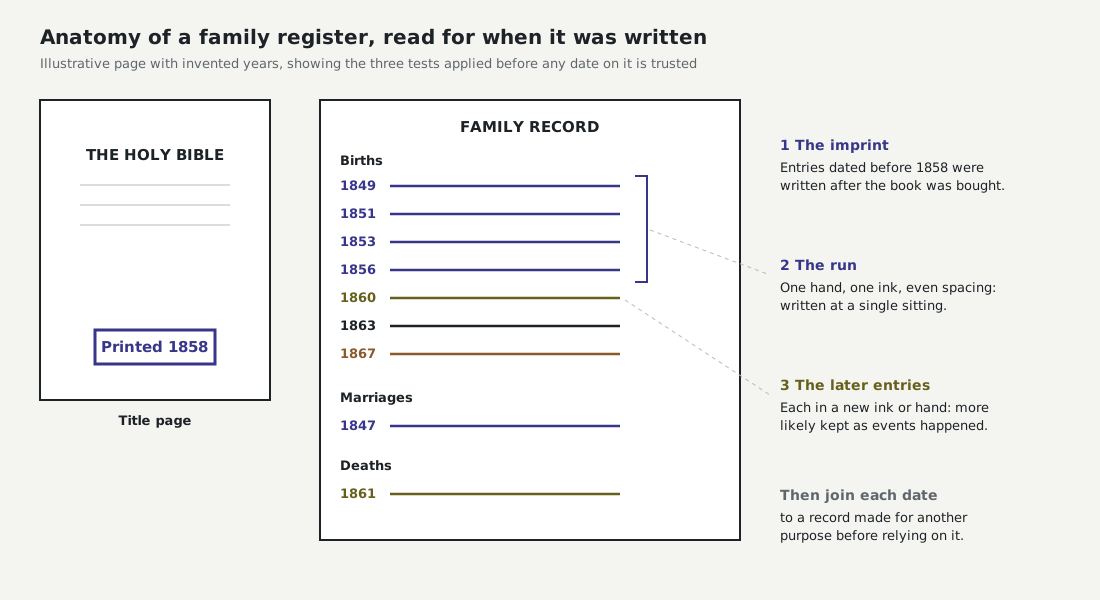
The mistake was simple and I made it with confidence. A family register came to me as a set of photographs of the leaves bound between the Testaments, and I built a chronology of births and deaths from it as though each line had been written the week it happened. Months later I asked for a photograph of the title page. The book had been printed several years after the first four births on its register.
Nothing on the register was false, as far as I know. What I had gotten wrong was the kind of evidence it was. The first four entries were a memory, written down in one sitting after the book was bought. Only the later ones were a record.
Why the family kept the count
Before the state took any interest in births, families kept count in the front of a book, and that is the whole appeal of the record. Texas did not begin registering births and deaths at the state level until 1903, and the state archives say it was as late as the 1930s before births were consistently recorded.1 If a birth before 1903 was recorded anywhere official, it was with the clerk of the county.1 Many were recorded nowhere, which is why the state began registering delayed birth certificates in 1939 for people whose births had never been set down at the time.1
So the family register often stands alone. That is its strength and the reason it has to be tested harder than a record with company.
Date the writing before the event
The rule I now follow is that every entry carries two dates: the date it states and the date it was written. The first is on the page. The second has to be worked out, and until I have worked it out the first is only a claim.
This is the position I would argue against most genealogists I know. An entry I can show was written within days of a birth outranks a county record of the same birth made decades later, including a delayed certificate registered in 1939 or later. The usual ranking puts the official paper first because an official made it. I put the contemporaneous paper first because the person holding the pen was there. A reasonable colleague would answer that a family has every motive to adjust a date, and that an official process at least applied a standard of its own. Granted, which is why the ranking only holds for entries I have actually dated by the writing. An undated family entry ranks below nearly everything.
Hands, inks and the imprint
The working sequence has three steps, and the order matters.
First, the imprint. The title page of the book gives the year it was printed, and sometimes the edition. Any entry for an event earlier than that year was written after the event, however neat it looks. That single test would have saved me months.
Second, the runs. I read the register for stretches written in one hand and one ink with the same spacing and the same pressure. A run like that was written at one sitting, whatever span of years it covers. A register that changes hand and ink with nearly every entry was more likely kept as events happened.
Third, the join to the outside. Each dated entry that can be matched to a record made for another purpose, a county marriage entry, a tax roll, a notice in a newspaper, either supports the register or catches it out. The joining method is laid out in the three records of one delegate, and it works the same way on a family.
None of these steps survives a poor copy. Ink color and pressure are exactly what a film or a flat scan drops, which is the problem described in the essay on what a digitized page loses. I ask for the original or a color image of it before I date anything.
Why a widow sent the book to Washington
The best evidence that families understood what these pages were worth sits in federal files. A widow applying for a pension on her husband’s Revolutionary War service had to prove the marriage, and some did it by sending family record pages from Bibles and other books along with the application.2 The National Archives counts more than 100 Bibles containing family information among its pension files, submitted because a wife or a parent had to prove the relationship to the soldier.3 One of them carries the family’s history written in the margins of the text itself.3
That history cuts two ways. It shows that a family register was accepted as proof by a federal office. It also means that some registers were read, and perhaps finished, with a claim in mind. When a page was produced for an application, I date its writing as carefully as any other and treat the marriage entry as the one line the applicant most needed to be there.
The same pages turn up closer to home. The state archives list family Bibles among the kinds of private papers held in their manuscript collections.4 The quarterly founded by the Texas State Historical Association filled its early issues with letters, diaries, journals and memoirs, material of the same private kind.5 A register that reached a public collection has usually passed through several hands, and each hand is a chance for a page to be copied, recopied or tidied.
Where the method stops
The method runs out in three places. A careful family could keep a register for fifty years in one hand with one bottle of ink, and my run test would call it a single sitting. A register copied faithfully into a new book, entry by entry, passes every test except the imprint, and a later copy of a later book passes that too. And the most common case of all defeats me: a single leaf, torn from its book, with no title page to date it and no neighbors to compare.
In those cases I cite the entry with a plain statement that I could not date the writing. The same caution runs through the next essay, on church registers, which were kept by an institution rather than a family and fail in different ways. The research behind my book on Coke drew on family records as well as public ones, and the reading rooms where such papers end up include the manuscript collections of the state archives in Austin; further record studies are listed on the archives index.
Every entry I cannot date by its writing costs me a sentence I would otherwise have been able to state as fact.
References
-
Texas State Library and Archives Commission, Texas Vital Statistics Indexes. ↩ ↩2 ↩3
-
National Archives, Prologue Magazine, Using Revolutionary War Pension Files to Find Family Information. ↩
-
National Archives, AOTUS blog, The Family Bible. ↩ ↩2
-
Texas State Library and Archives Commission, African American Genealogy at the Texas State Library and Archives. ↩
-
Handbook of Texas Online, Texas State Historical Association, Texas State Historical Association. ↩