The call came on a Wednesday afternoon from a credit officer at an equipment finance company, a man I had never met, about a company where I sat on the board. He wanted to confirm where nine units were parked and the hour meter readings on four of them before his annual review. He did not ask about revenue, customers or the plan for next year. When I offered to send him the quarterly summary the directors receive, he thanked me and said he would rather have photographs of the data plates.
I have thought about that call more than its length deserved. He was looking at the same company I was, through the same balance sheet, and reading a different document.
One line, two readings
The line is property and equipment, net of depreciation, usually the largest asset an oilfield services company owns. Two people look at its single figure and see two things.
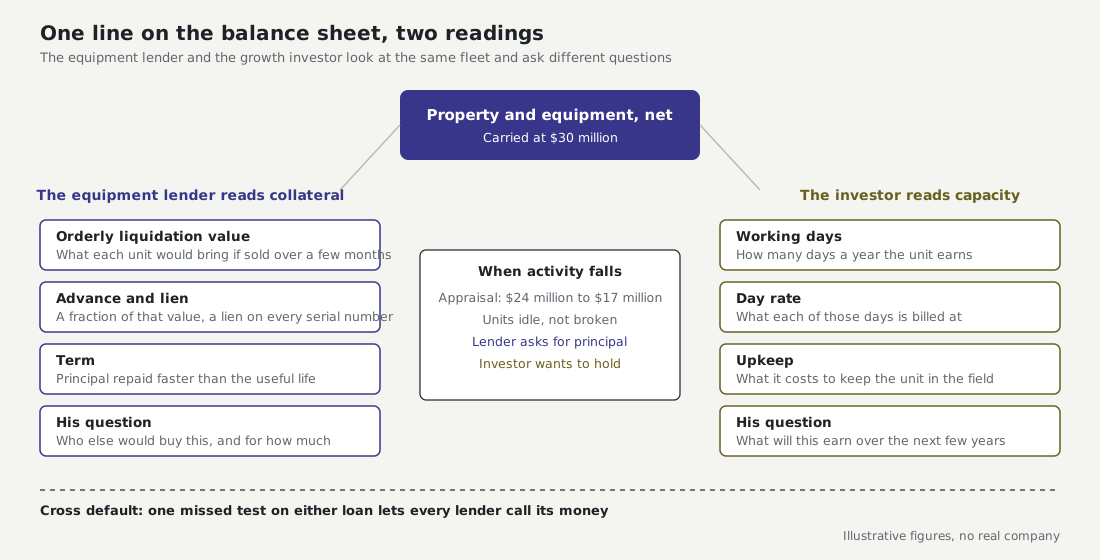
The equipment lender sees collateral. His question about each unit is what it would bring if he had to repossess it and sell it over a few months without a fire sale, the figure appraisers call orderly liquidation value. He advances some fraction of that, collects principal over a term shorter than the useful life, and files a lien against each serial number. For him the fleet is a list of titled objects, and his loan is safe exactly to the extent that list would sell.
The investor who put in growth equity sees capacity. His question about the same unit is how many days a year it works, at what day rate, and what it costs to keep running. A pump with forty thousand hours on it, to him, is a machine that has shown it can do the job. To the lender it is a machine that much nearer the auction yard.
Neither reading is wrong. They answer different questions, and the answers drift furthest apart in precisely the year a company needs them to agree.
When the readings collide
Take a hypothetical fleet carried at $30 million net, financed in part by a $14 million equipment note. In a busy year an appraiser might set orderly liquidation value close to book, say $24 million, and everyone is comfortable. Then activity falls. Service pricing softens because too much equipment is chasing too little work; the Energy Information Administration attributed part of the drop in well costs after 2012 to a surplus of rigs and service companies.1 Used equipment prices follow the same road down. The next appraisal comes in at $17 million. Nothing about the trucks has changed. The lender’s cushion has lost $7 million while his balance has fallen only by what the amortization schedule allowed.
The investor sees idle units that will work again. The lender sees his appraisal and asks for principal or more collateral. Each is right by his own document.
What decides which of them prevails is usually one clause, cross default. Many equipment notes provide that a default under any other agreement of the borrower is a default under the note, and the operating line tends to say the same in reverse. With both clauses in place, a missed test on one facility gives every lender the right to call its loan, and a creditor whose only real concern was nine serial numbers acquires a vote on whether the company lives.
My view, which I know good directors reject, is that a service company should refuse cross default between its equipment notes and its operating line, and should accept a higher rate to get that refusal. Tie each lender’s claim to what it financed and nothing more. The objection is serious. The rate difference compounds for years, and in a real downturn, the argument goes, every creditor ends up in the same room anyway. My answer is that the room is the whole point. A company working through a bad year with one lender at a time negotiates on its own calendar. A company whose defaults travel together negotiates with a crowd, on the calendar of its most nervous member.
I would also put the lender’s appraisal in front of the board once a year, next to book value. The gap between the two is a quiet verdict on the depreciation policy, and most boards never see it.
Where the lender saw further
Once I treated a low appraisal as timidity and encouraged a management team to push back on it. The units were a specialized configuration built for one narrow kind of work, and the appraiser had marked them well below book. I assumed he had used the wrong comparable sales. He had used the only ones there were, and there were few, because almost nobody else wanted that configuration. Our book value assumed a buyer who did not exist. The lender understood that equipment better than the board did, because he had asked the one question we had skipped, which was who else would want it.
That is where the investor’s reading runs out. Capacity is worth something only while the work lasts, and a unit built for a narrow purpose is a wager that the purpose outlives the note. A payroll register shows a board which work management believes in, as I argued in the piece on reading headcount by role; the appraisal shows which equipment the rest of the market believes in. A combination assembled from several small fleets meets the same question at larger scale, one reason I doubt that a roll up performs the way its model says.
The habit of asking what a thing would bring on a bad day came to me in energy banking, long before I sat on boards, and it has followed me through the rest of my working life. It is an old question in the oil business, older than any fleet I have seen appraised, and it sits beneath the story of Dallas and its oil money as surely as beneath my writing on energy companies.
The credit officer called again the next year, and the year after that. I came to understand that his file on the company was, in practice, him: his photographs, his notes on which yard manager picked up the phone, his sense of whether the numbers he asked for arrived when promised. When a covenant finally came close, the conversation that mattered was with that one man, and it went well because he had spent three years learning that the units were where the company said they were. Every loan agreement reads as though two institutions wrote it. In a bad year it is administered by the person behind the paper.
References
-
U.S. Energy Information Administration, Trends in U.S. Oil and Natural Gas Upstream Costs ↩